
Corn Cob Granules Export from Pakistan: Industrial Uses and Global Demand
Ask ten buyers what “corn granules” means and you may get two answers. Some mean maize grits or cornmeal for […]
Ask ten buyers what “corn granules” means and you may get two answers. Some mean maize grits or cornmeal for […]
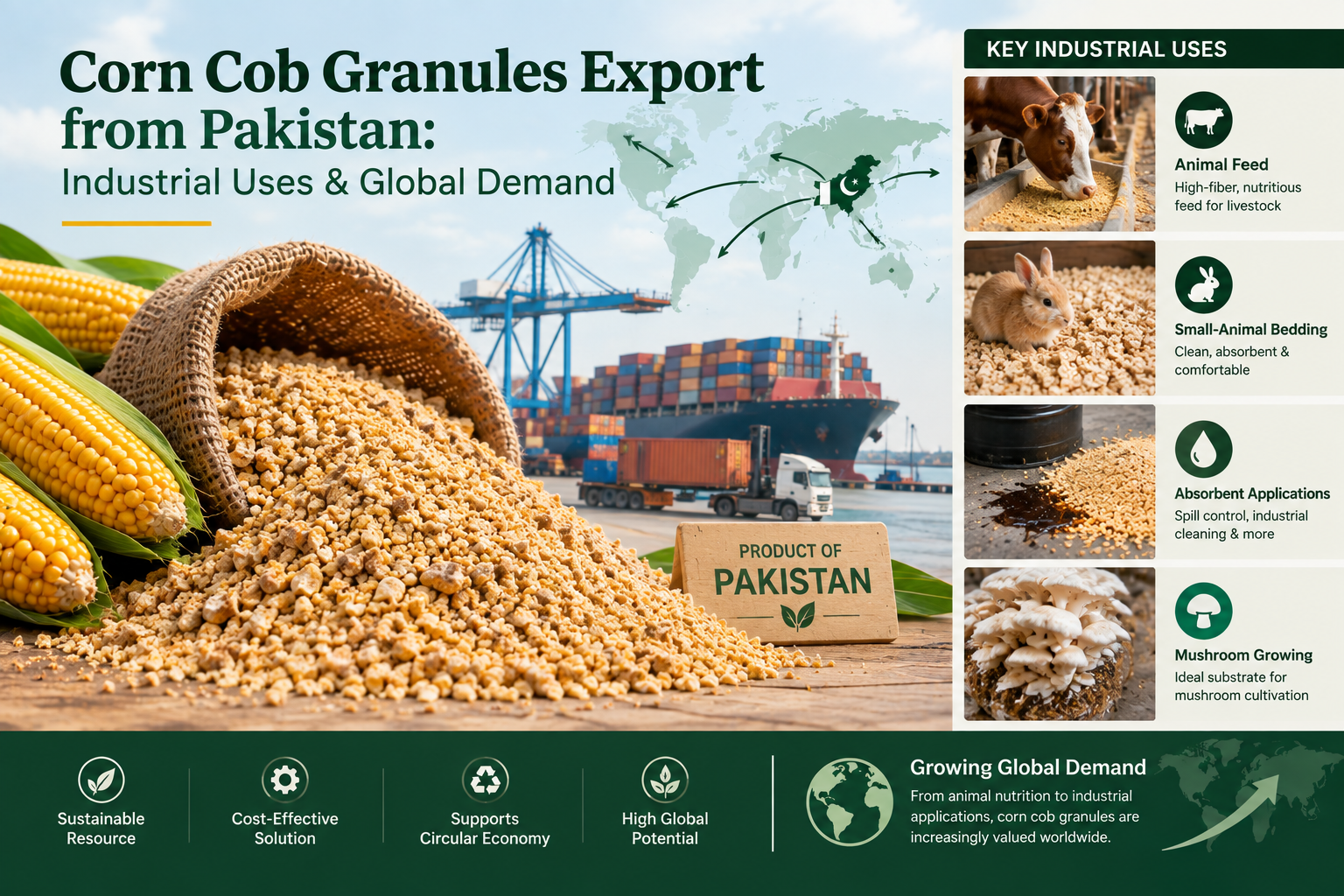
Ask ten buyers what “corn granules” means and you may get two answers. Some mean maize grits or cornmeal for food processing. Others mean corn cob granules, the hard, woody part of the cob that is dried, crushed and screened into a graded material. This article covers the second kind. It is a low-cost agricultural by-product with a surprisingly wide industrial footprint, and a practical option for importers looking at corn cob granules export from Pakistan.
If you buy for a blasting-media company, a pet-bedding brand, an agricultural-input business or a biomass trader, the useful questions are narrow. What decides whether a lot is good? What can go wrong between the field and your warehouse? What does a Pakistani exporter need to do before the container leaves? The sections below take those in order.
What corn cob granules actually are
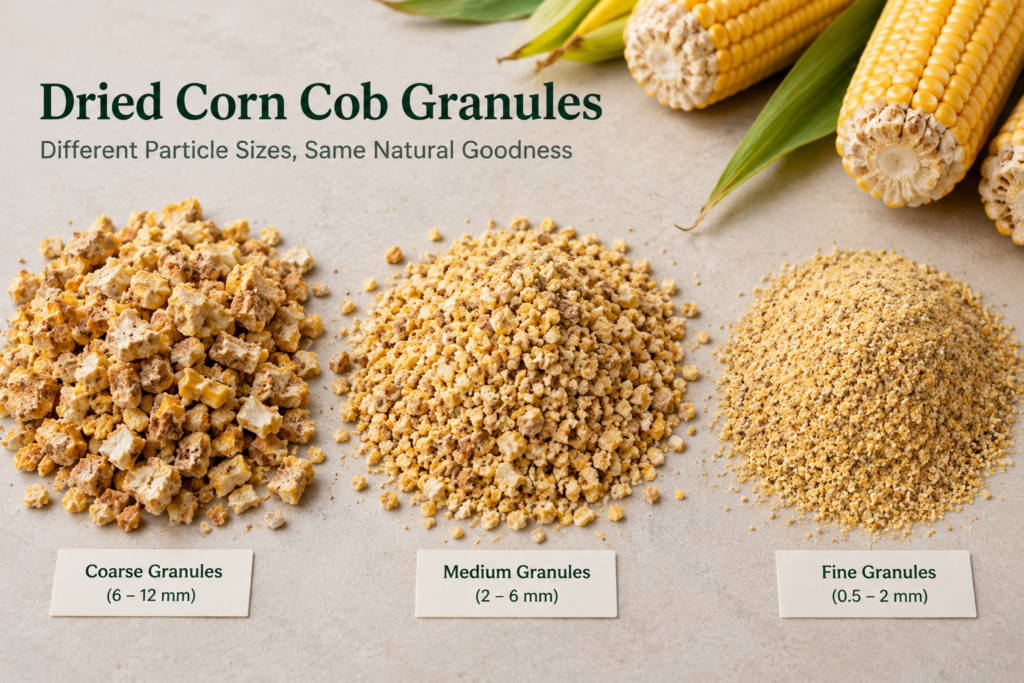
A corn cob is the core the kernels grow on. After the kernels are removed, the cob is left as a by-product of maize processing. Processors dry it, break it down mechanically, and sieve it into particle-size ranges. Depending on the process, the output is sold as granules, grit, meal or powder. The names overlap between suppliers, so do not assume that “granules” from one company matches “granules” from another. Ask for the mesh range in writing.
Corn cob is mostly lignocellulosic. It contains a lot of hemicellulose, which is why research groups and chemical producers have long treated it as a feedstock for xylose, xylitol and furfural, as this open-access bioengineering study describes. That chemistry explains two practical properties. The material is fibrous and absorbent, and it is renewable and biodegradable.
Why Pakistan is a credible sourcing origin
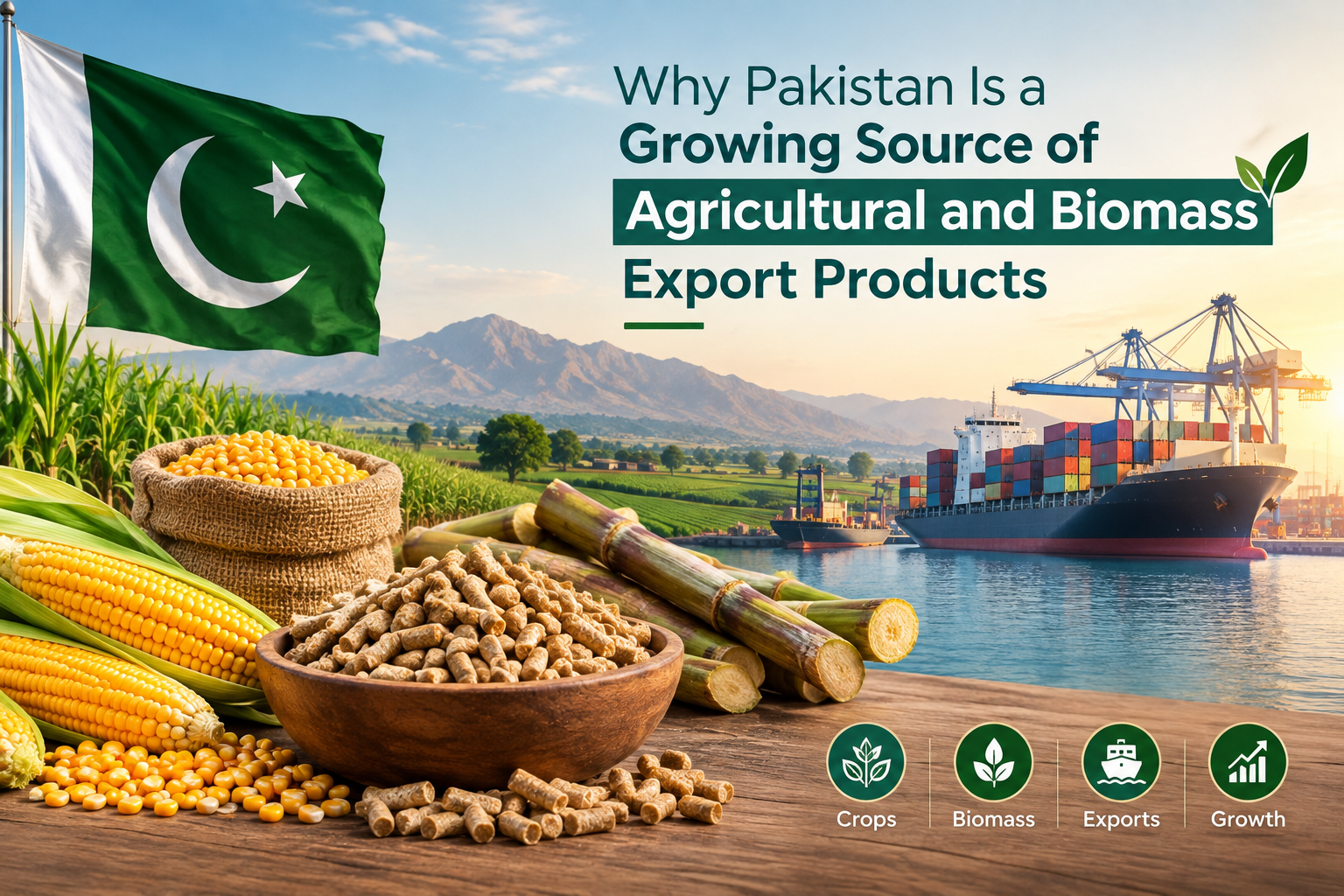
Granules only exist where there is a steady supply of cobs, so the maize base matters. The U.S. Department of Agriculture’s attaché office in Islamabad, in its April 2026 Grain and Feed Annual, puts 2025/26 corn production at about 9.5 million tons and forecasts 9.6 million tons for 2026/27. Much of that maize goes to poultry feed and wet milling, and cobs come out the other end of shelling operations.
Two caveats apply. The USDA figure describes grain, not cobs, so it says nothing about how many cobs are actually collected, dried and available as clean export material. And a large maize crop does not make every supplier reliable. Availability, cleanliness and consistency still have to be checked lot by lot.
Where corn cob granules are used
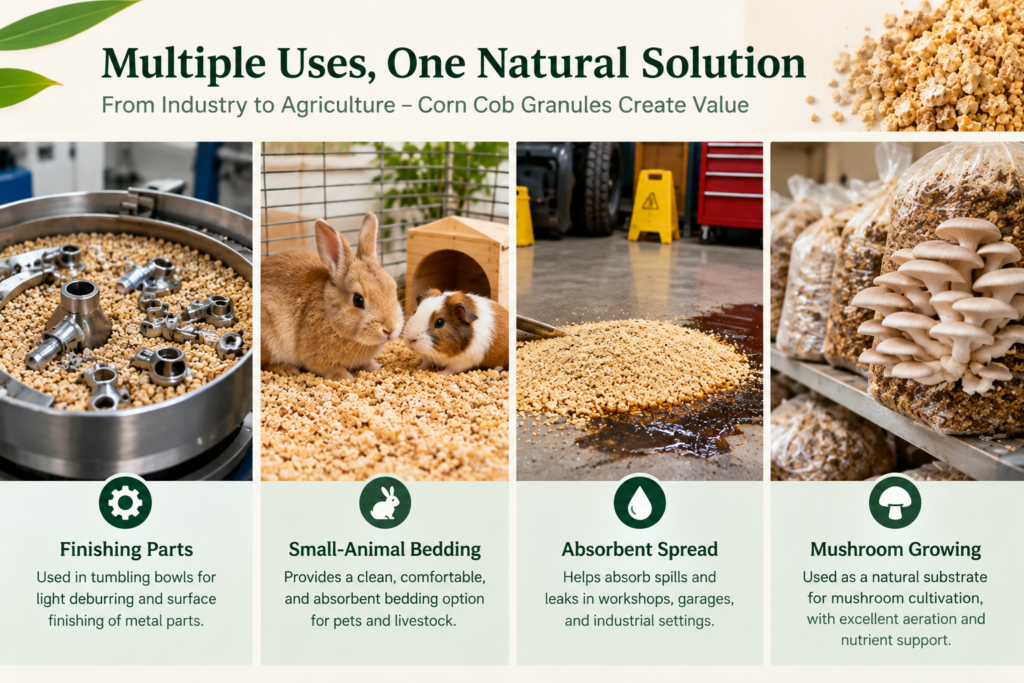
Demand for the granules comes from several unrelated industries, which is part of why the product stays in steady use. These are the main ones.
Surface finishing and blast cleaning
Cob granules are widely used as a soft abrasive. Because the material is much gentler than sand or metal grit, it can clean, polish or dry parts without etching the surface underneath. Typical uses are tumbling and vibratory finishing of small metal components, cleaning wood or delicate substrates, and final drying stages in finishing lines. Buyers here care most about particle size distribution, dust level and freedom from stones or grit.
Animal bedding and pet litter
Absorbency and low cost make cob granules a common bedding material for small animals, poultry and some livestock uses. Brands in this segment will care about odor, dust, moisture content and, above all, hygiene. A single contaminated batch can turn into a return problem, so cleanliness matters more than a small price difference.
Absorbents and spill control
Granules are also sold as an oil and liquid absorbent for workshops and industrial floors. This is a low-margin, high-volume corner of the market, so bulk density and packaging efficiency have a direct effect on freight cost per usable kilogram.
Carriers, substrates and agricultural inputs
Ground cob can act as a carrier for feed supplements or agricultural additives, and as a component in growing substrates such as mushroom cultivation blends. Daa Agri’s own product range lists granules for absorbent applications, substrate blending, animal bedding and agricultural input use, and a separate cob meal line for finer applications.
Biomass and chemical feedstock
Outside the granule market proper, cob is also burned for heat, pressed into biomass products, or processed for chemicals. Most buyers of graded granules are not in this segment, but it competes with them for raw cobs, which can push up raw-material prices in strong-demand seasons.
What “global demand” really means here
You will find a lot of confident market-size numbers for corn cob products online. Most come from paid research summaries that do not show their method, and I have not been able to trace a reliable public figure specific to corn cob granules. Rather than quote one, it is more honest to describe what drives demand.
The first driver is that several industries use the same raw material for different reasons: finishing, bedding, absorbents, agri-inputs. Weakness in one segment rarely hits all of them. The second is the preference for renewable, biodegradable materials over mineral or synthetic ones in applications where performance is comparable. The third is cost: cob is a by-product, so it can be priced below many alternatives.
Most of this demand is met by established producers in several countries, which means a new Pakistani supplier is competing on consistency, documentation and delivery reliability, not on novelty. That is the framing to use when you evaluate any corn cob granules supplier.
How to judge a supplier before you order
Specifications differ by application, but the same short list of questions covers most cases.
| What to check | Why it matters |
|---|---|
| Mesh or particle size range | Determines whether the lot suits blasting, bedding or blending; ask for the sieve range, not a marketing grade name |
| Moisture content | Affects mould risk in transit and shelf stability; buyers usually set a maximum |
| Foreign matter and dust | Stones, soil and fines cause complaints, especially in finishing and pet products |
| Bulk density | Changes how much fits in a bag or container, and therefore freight cost |
| Batch consistency | A good sample means little if the second shipment looks different |
| Absorbency or other performance tests | Relevant if the granules are sold as a bedding or absorbent product |
Ask for a pre-shipment sample from the actual production batch, not a hand-picked one. If your product is sold under your own brand, agree in advance what a pass or fail looks like, and whether an independent inspection is appropriate.
Also ask how the supplier controls moisture and contamination. According to the company’s site, Daa Agri Limited is a Pakistan-based agricultural processing and export company whose process runs from sourcing residues through cleaning, drying, grinding and moisture checks to export packing. It says cobs are sourced directly from farms and mandis across Punjab and ground to uniform mesh sizes. Specific test values, certifications and minimum order quantities are not published there, so treat those as questions to put to the team directly.
Packaging and shipping
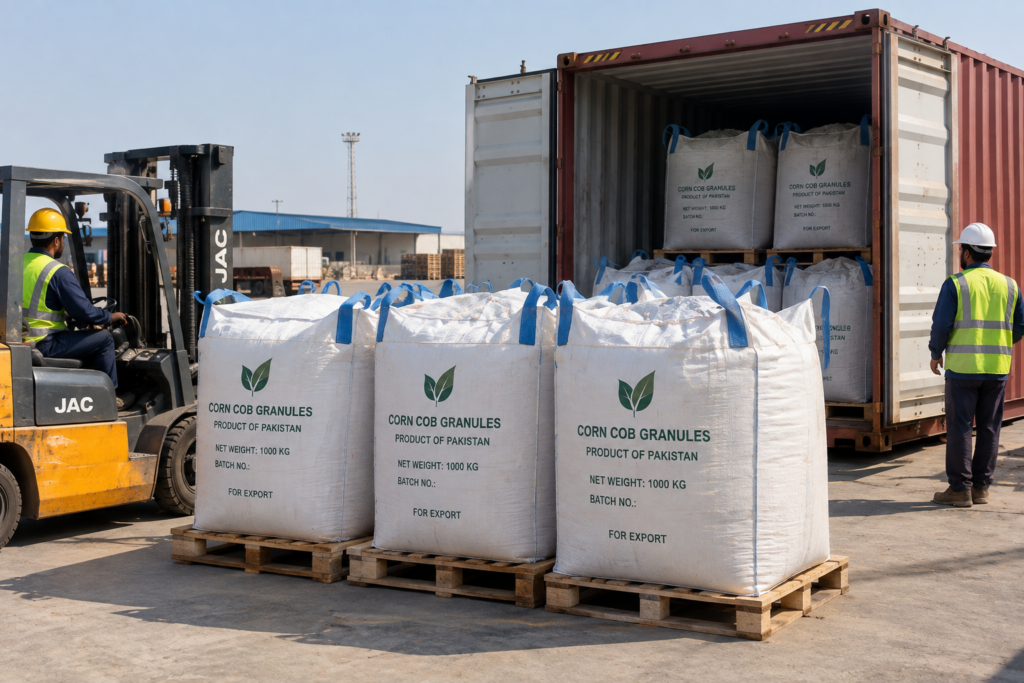
Corn cob is light and bulky, so packaging choices affect cost more than they would for grain. Woven polypropylene bags and jumbo (bulk) bags are the usual formats. Daa Agri’s site mentions both, with containerized export handling. Confirm the bag size, liner, labelling and pallet arrangement in writing, especially if you resell under your own label.
Keep the material dry. Moisture reaching a container during a long sea voyage is the most common avoidable problem with bio-based bulk cargo. Ask how the exporter manages this, including container checks and desiccant or liner use where appropriate.
Routing deserves a direct question in 2026. The USDA attaché’s July 2026 Grain and Feed Update notes that the closure of the Strait of Hormuz has created logistical difficulties for Pakistani rice exports. That report is about rice, not cob products, but shipping conditions from Pakistan can affect other agricultural cargo too. Confirm the expected route, transit time and any surcharges before you agree to delivery terms.
Export documentation from Pakistan
The paperwork can look long, but most of it runs through a few official channels.
The Pakistan Single Window is the government’s digital platform for lodging the information and documents needed for import, export and transit clearances in one place. Exporters file their goods declaration there. The Trade Development Authority of Pakistan is the trade-promotion body under the Ministry of Commerce, and it is the reference point for exporter facilitation.
For plant-derived material, the destination country may require a phytosanitary certificate. The Department of Plant Protection’s page on PSW explains that for commodities under its remit, the export certificate request is generated when the single declaration is submitted. Whether a specific corn cob product needs one depends on the importing country’s rules, so ask the importing authority or your customs broker instead of assuming.
Beyond those, expect the usual commercial documents: invoice, packing list, bill of lading, and a certificate of origin where the destination requires it. Payment terms, incoterms and inspection rights belong in the contract, not in an email thread.
Working with a Pakistani exporter
If you are new to sourcing from Pakistan, run a small trial order before committing to volume. Compare the shipped goods against the approved sample, note how the supplier handles questions and delays, and check that their documents match the physical cargo. A supplier who answers technical questions specifically is usually a better bet than one who sends only a price list.
Frequently asked questions
Is “corn granules” the same as corn cob granules?
Not necessarily. “Corn granules” can refer to maize grits for food use. Corn cob granules are made from the cob itself and are used in industrial, animal-care and agricultural applications. Confirm which one a supplier means before comparing quotes.
What particle size should I ask for?
It depends on the use. Finishing and blasting work generally calls for tightly graded, cleaner material, while bedding and absorbent uses often tolerate a wider range. Ask suppliers for the sieve range as a number, and test a sample in your own process.
Do I need a phytosanitary certificate?
That depends on the importing country’s plant-health rules. Check with your national authority or customs broker. On the Pakistani side, the request is handled through PSW.
Can I buy small trial quantities?
Some exporters accept them and some do not. Minimum order quantities are not published on Daa Agri’s site, so ask the team directly.
How do I compare quotes from different suppliers?
Line them up on the same terms: mesh range, moisture limit, packaging, incoterm and port. A lower price with a wider moisture tolerance or looser sizing is not a like-for-like offer.
Before you place the first order
Corn cob granules are a modest product with a wide set of uses, and most problems in this trade come from unclear specifications, not from the material itself. Write the specification down, test a real sample, and keep the paperwork consistent with the cargo.
If you are considering corn cob granules export from Pakistan for your own program, you can share your product requirement, quantity, destination and packaging needs with the Daa Agri team and see what supply details they can offer.
https://daaagri.com
info@daaagri.com

Turn industry knowledge into a supply conversation.
Contact GreenCore for product availability, specifications, bulk packaging and export support.