
Crushed Corn Cob Export from Pakistan: A Buyer’s Guide for Industrial and Agricultural Uses
Corn cob is what remains once the kernels are stripped from the ear. It is usually sold as a low-cost […]
Corn cob is what remains once the kernels are stripped from the ear. It is usually sold as a low-cost […]
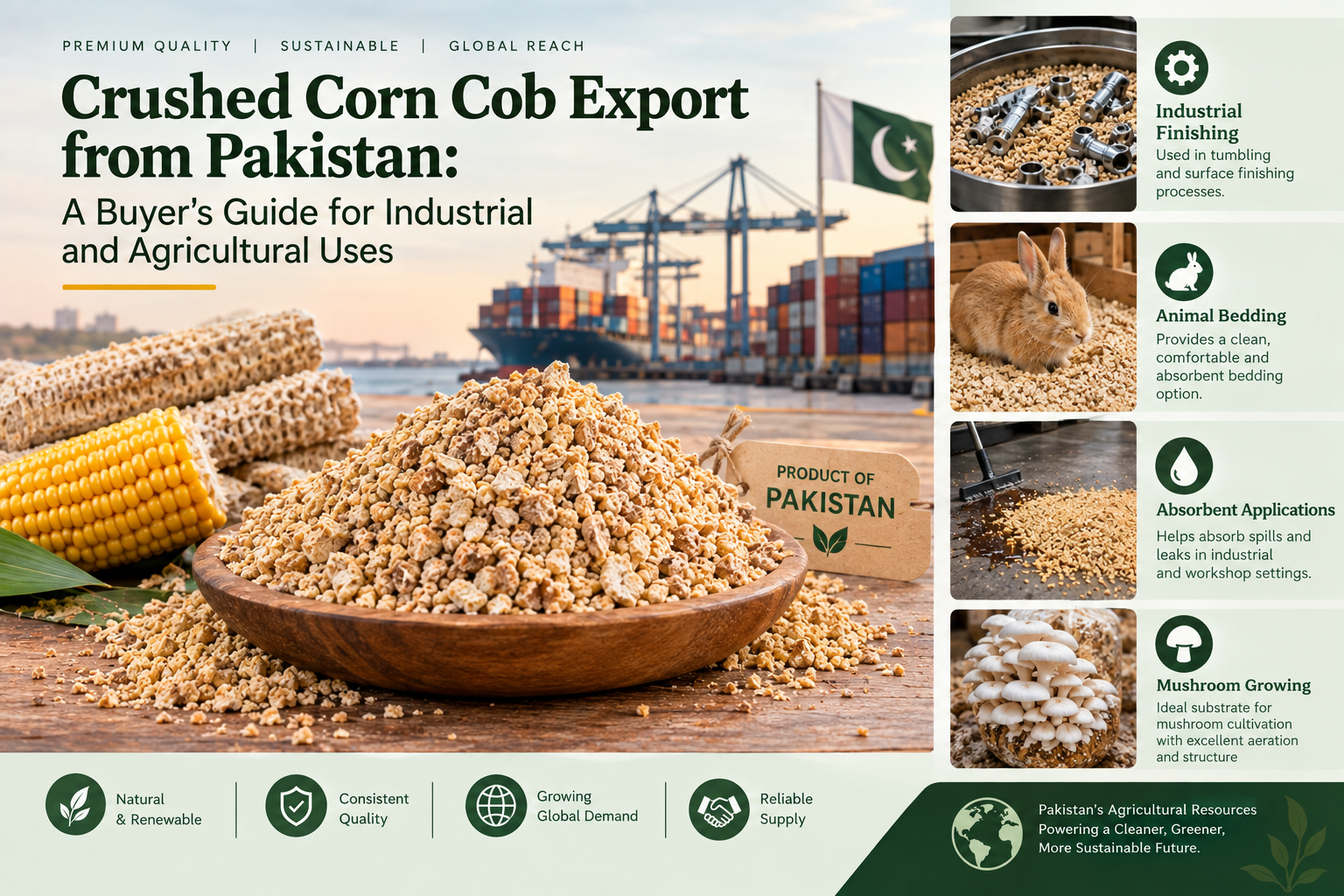
Corn cob is what remains once the kernels are stripped from the ear. It is usually sold as a low-cost by-product, but crushed cob is a working raw material in several industries, and buyers who source it across borders face questions that have little to do with price. What size is the crush? How dry is it? Which paperwork does the destination country ask for? And is the supplier processing the material or just moving bags?
This guide covers those questions from the buyer’s side, with a focus on sourcing crushed corn cob from Pakistan.
Why Pakistan is a logical place to source corn cob
Corn cob is available wherever maize is grown at scale, and Pakistan grows a lot of it. USDA’s Islamabad office notes that maize output rose from about 1.66 to over 9.6 million tons between 2001 and 2025. It also forecasts around 9.6 million tons for 2026/27. Much of that grain goes to poultry feed, which is the country’s largest corn user.
Those figures describe grain, not cob. Cob volumes aren’t published in official statistics, so treat any supplier’s claim about “available tonnage” as something to ask about directly. What the grain numbers do show is a large, established maize-growing base, and that is where cob supply comes from.
What crushed corn cob is
The FAO’s agricultural vocabulary describes maize cobs as the fibrous central core of the ear. It lists fuel, animal litter, mulch and soil conditioner among the traditional agricultural uses. Cob is mainly cellulose, hemicellulose and lignin. Published percentages differ from one study to another because of variety, maturity and how samples were prepared, so ask a supplier for a test report on the batch you are buying rather than relying on a textbook figure.
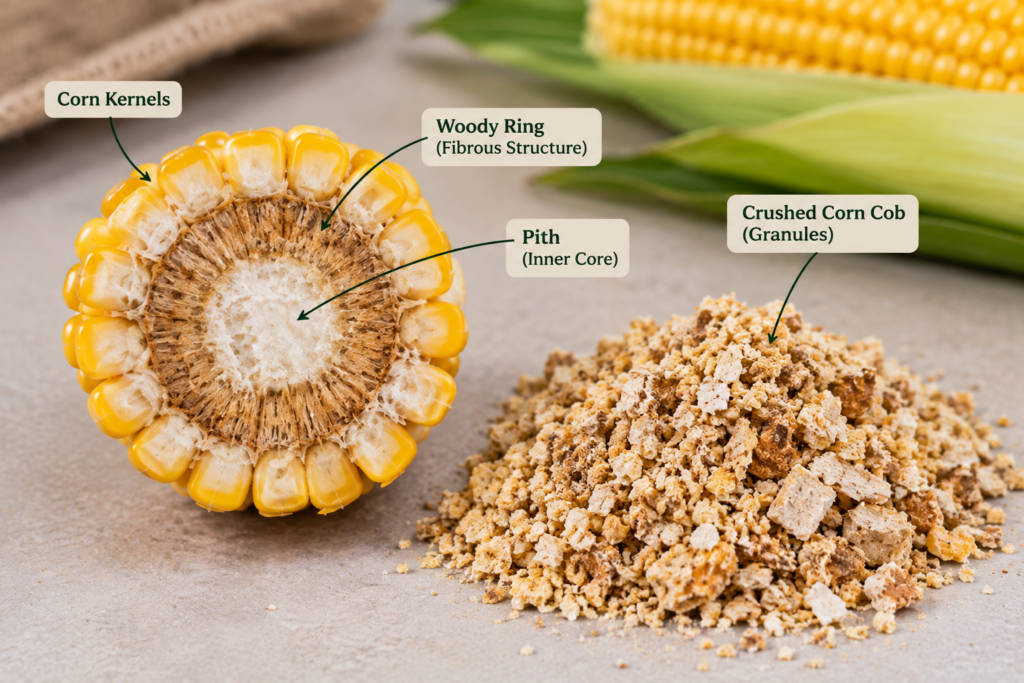
The cob is not uniform inside. It has an outer chaff, a hard woody ring and a soft pith, and these parts have quite different physical properties. That is why processors have long struggled to tailor cob products to different markets, and it explains why crush size and cleaning matter so much to the end use.
Where industrial buyers use it
Because the material is fibrous, absorbent and biodegradable, the applications are varied. Patent literature on cob processing lists abrasives, animal bedding, oil-spill absorbents, carriers for agricultural chemicals and cellulosic raw material for molded goods, among others. In practice, buyers tend to fall into a few groups:
- Surface finishing and cleaning: ground cob is used as a gentle blasting and polishing medium.
- Animal bedding and litter: absorbency and dust level matter most here.
- Agricultural inputs: cob serves as a carrier, a substrate component or a composting ingredient.
- Biomass and energy: cob can be a fibrous feedstock for fuel products.
Daa Agri’s site positions its crushed corn cob as fiber-rich material for agricultural inputs, biomass support and bulk industrial use, alongside corn cob meal and granules. That range is typical. One bag of “crushed cob” cannot serve a polishing plant and a bedding manufacturer equally well, so the first task for any buyer is to define the application.
What to specify before you request a quote
Most disputes in this trade come from vague specifications. Before contacting an exporter, decide these points:
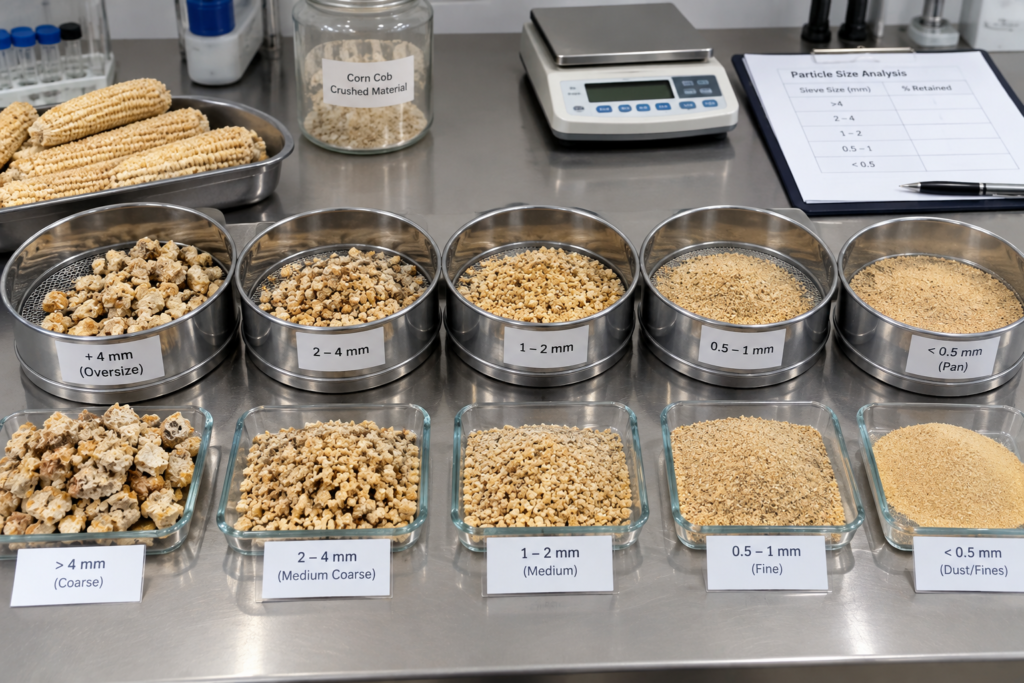
Particle size. Crushed cob, granules and meal are different products. Give a size range, and ask how the supplier measures it (screening or sieve analysis).
Moisture. Wet cob can mold in transit, and a container of it can arrive as a different product from the one you approved. Set a maximum moisture level and ask for test results per batch.
Cleanliness. Soil, stones, husk fragments and stray metal cause trouble in blasting and bedding applications. Ask what cleaning and contamination checks happen before packing.
Color and odor. They are subjective, but they signal age and storage conditions. A reference sample settles the argument in advance.
Packaging. Options include PP bags, jumbo bags or custom packing. Daa Agri lists export packaging in PP and jumbo bags among its services. Choose based on how you handle material at your end: pallets and forklifts favor jumbo bags, while smaller operations may prefer manual-handling bag sizes.
Volume and frequency. State whether you need a one-off container or a recurring program. Suppliers plan differently for each.
Processing quality: what to look for in a supplier
A trader who buys cob from many farms and bags it unchanged is a different kind of supplier from a processor who controls the steps in between. Neither is automatically wrong, but you should know which one you are dealing with.
Daa Agri describes itself as a Pakistan-based processor and exporter of agricultural by-products, with a focus on corn cob and sugarcane-derived residues. On its About page, it lists cleaning, drying, sorting, size reduction, quality checks and export packaging among its operations. Whatever supplier you consider, ask them to walk you through the same sequence: where the cob comes from, how it is dried, how it is sized and how each lot is checked before loading. Ask for a pre-shipment sample that matches what you will actually receive, not a hand-picked best case.
Export documentation and compliance
Documentation depends on the destination country, so confirm requirements with your own customs broker and import authority. A few general points hold across most shipments.
Cob is a plant product, so a phytosanitary certificate may be required by the importing country. In Pakistan, the Department of Plant Protection issues phytosanitary certificates and handles applications through Pakistan Single Window, and the export certificate request is generated when the Single Declaration is submitted. Pakistan also exchanges certificates electronically through the IPPC’s hub, which Business Recorder reported had already carried over 10,000 e-certificates to 77 countries by early 2024. Whether your destination accepts electronic certificates is something to verify with your own plant protection authority.
Beyond that, expect the usual commercial documents: invoice, packing list, bill of lading and certificate of origin. If your application involves regulated sectors, such as agricultural inputs, feed-related uses or organic production, ask your importer about additional rules before you order, not after the container ships.
Logistics and timing
Shipping cob is mostly about volume. The material is light and bulky, so a container fills up before it reaches its weight limit. Ask the supplier how many tons they realistically load per container and in what packaging, then compare quotes on a per-ton delivered basis.
Route risk is worth checking too. USDA’s July 2026 update describes logistical challenges for Pakistani rice exports linked to the closure of the Strait of Hormuz. That report concerns rice, not cob, but it shows that shipping conditions can change. Confirm current routing, transit times and freight quotes at the time you order.
Questions to ask before placing a first order
- Can you send a sample and a test report for the batch it came from?
- What are the particle size range and maximum moisture you can commit to?
- Which packaging formats do you offer, and how are containers loaded?
- What documents do you supply, and which will my destination require?
- How is quality checked before shipment, and what happens if a lot misses the agreed specification?
- What is realistic lead time for a first shipment and for repeat orders?
Suppliers who answer these clearly and consistently tend to be easier to work with over time. Vague or shifting answers are worth noting.
Frequently asked questions
Is crushed corn cob the same as corn cob granules or meal?
Not exactly. The names describe different particle sizes and finishes, and suppliers don’t always use them the same way. Agree on a numeric size range rather than relying on the label.
Can corn cob be used as animal bedding?
Yes, it is a known use because of the material’s absorbency. Dust level and moisture matter for this application, so specify both.
Does crushed corn cob need a phytosanitary certificate?
It depends on the importing country’s rules. Pakistan’s Department of Plant Protection issues export certificates, but confirm what your destination requires before shipping.
How much does it cost?
Prices vary with size, moisture, packaging, volume and freight, so any number quoted without those details is not meaningful. Ask for a written quote that specifies each factor.
Can I get a sample before ordering?
Ask for one. Get a sample and a lab report tied to the same batch, and compare your first shipment against them.
Next steps
If you are comparing suppliers for crushed corn cob, start with your application, size range and packaging. Then share those details, along with quantity and destination, with the exporters on your shortlist. You can learn more about Daa Agri’s range on the company website and its inquiry form asks for exactly these details.
info@daaagri.com
Turn industry knowledge into a supply conversation.
Contact GreenCore for product availability, specifications, bulk packaging and export support.