
Biomass Export from Pakistan: Products, Uses & International Market Potential
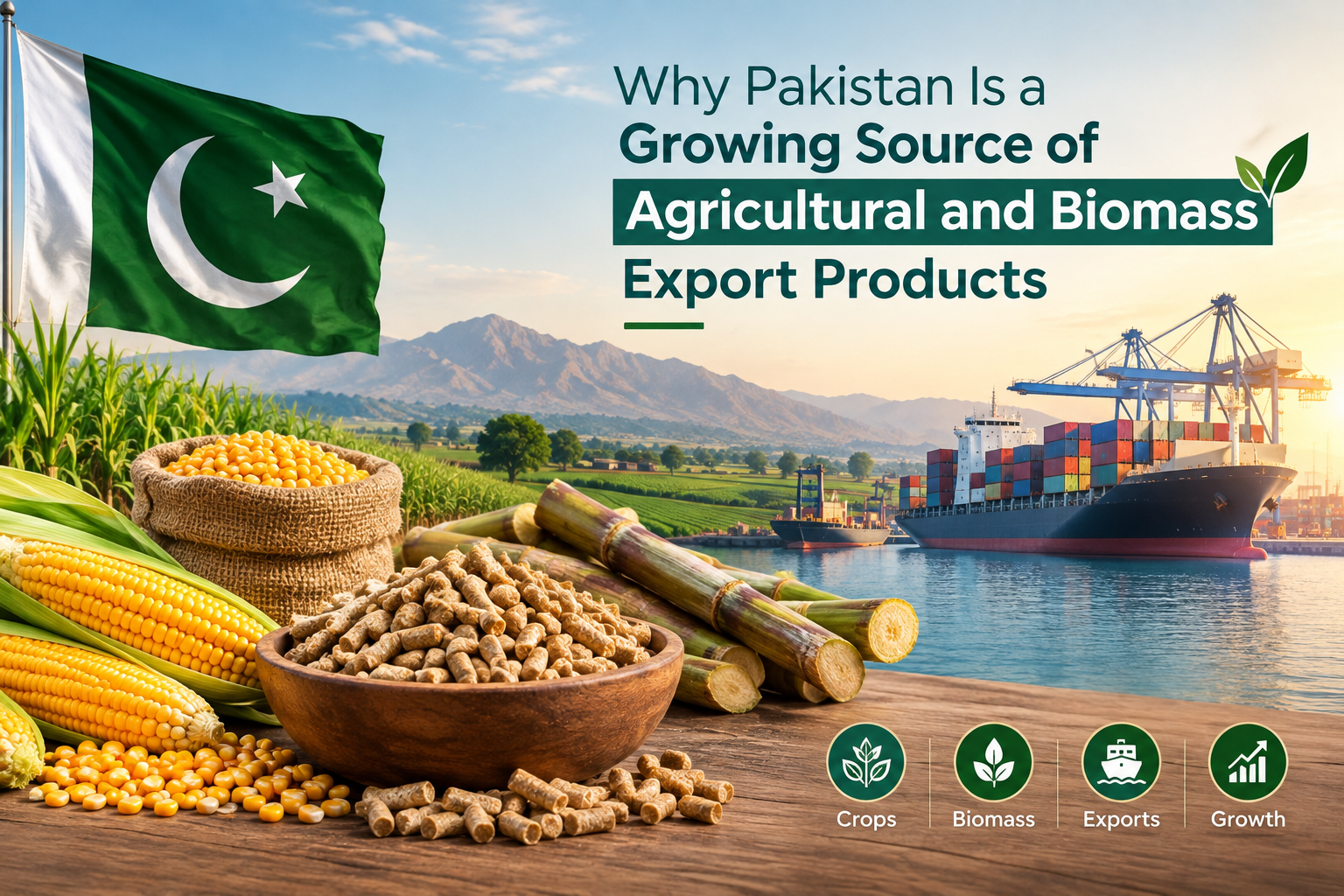
Pakistan sits on one of the most underutilised agricultural resource bases in Asia. Millions of tonnes of crop residue — […]
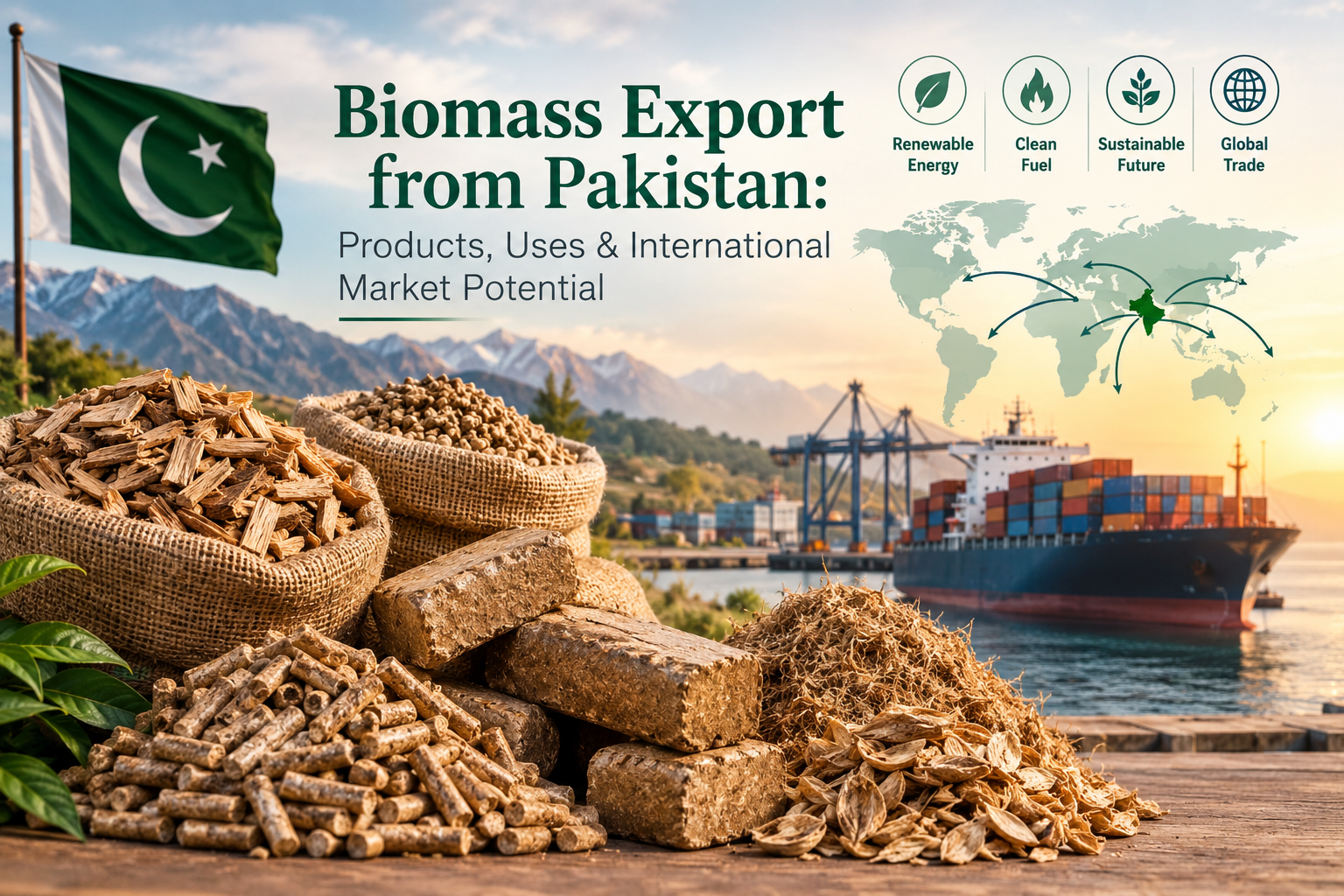
Pakistan sits on one of the most underutilised agricultural resource bases in Asia. Millions of tonnes of crop residue — […]
Pakistan sits on one of the most underutilised agricultural resource bases in Asia. Millions of tonnes of crop residue — wheat straw, rice husk, cotton stalks, sugarcane bagasse — are generated every harvest cycle, much of it burned in open fields or left to decompose. What is only now becoming apparent to international buyers and procurement managers is that this waste stream represents a commercially significant, price-competitive source of biomass feedstock for power generation, industrial heating, and renewable energy compliance programmes worldwide.
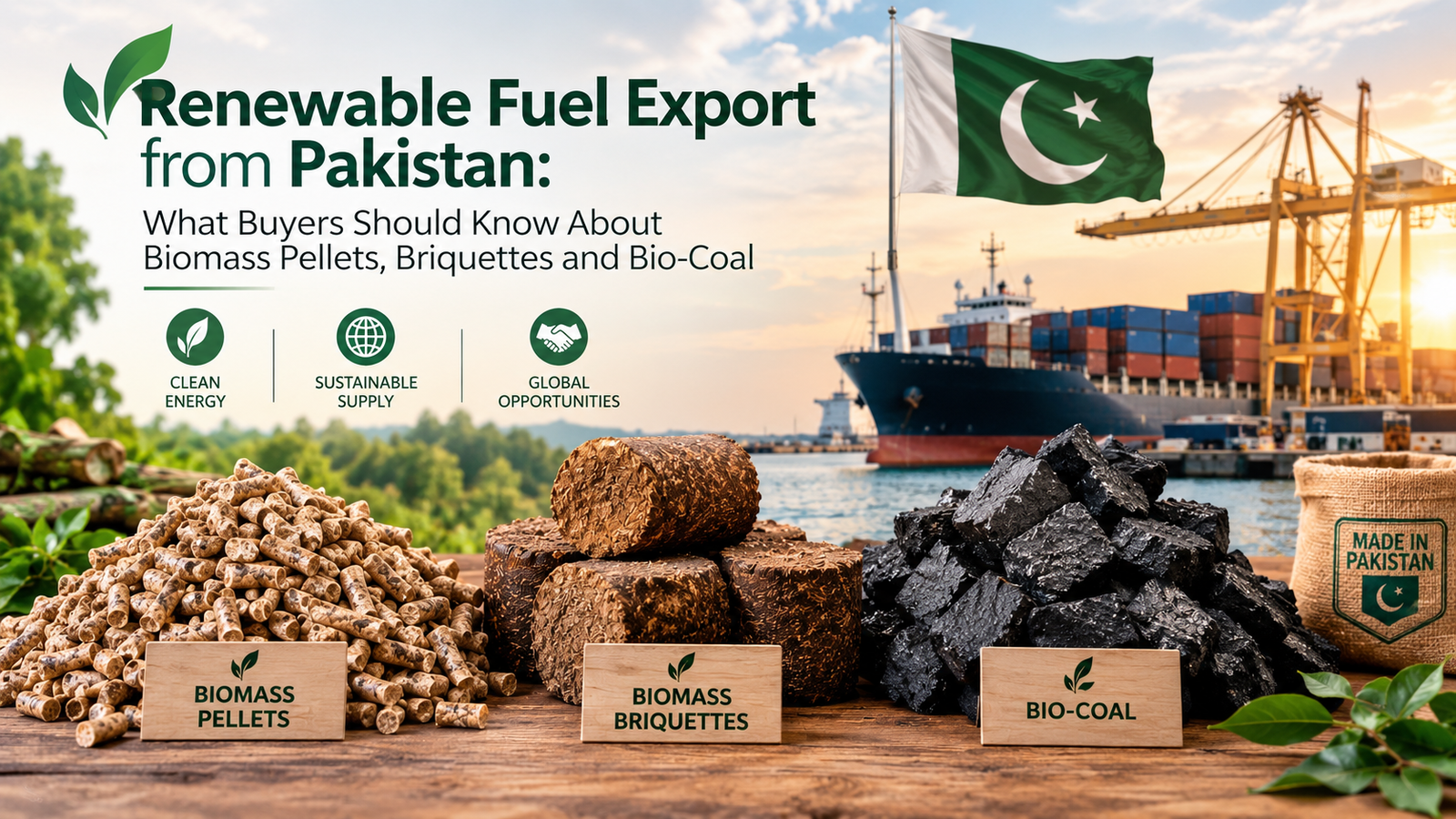
This article explains what biomass products Pakistan can realistically supply, who is buying them internationally, what quality and certification standards matter, and what importers should evaluate before engaging a biomass supplier from Pakistan.
Pakistan’s Biomass Resource Base: What the Numbers Actually Mean
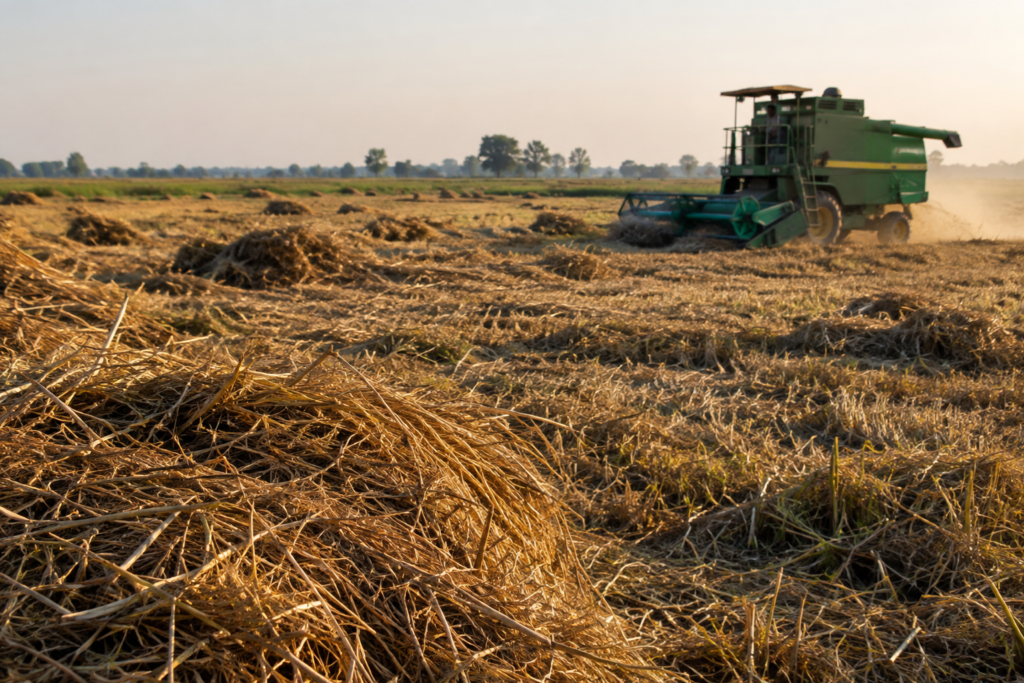
Pakistan is one of Asia’s larger agricultural economies, with roughly 26 million hectares of cultivated land, according to World Bank data. Five crops — wheat, rice, sugarcane, maize, and cotton — account for the overwhelming share of crop biomass generated annually.
A field survey dataset published through the World Bank’s Energy Sector Management Assistance Program (ESMAP) mapped Pakistan’s biomass feedstock yield by district and residue type, covering wheat straw, rice husk, rice straw, cotton stalk, sugarcane trash, bagasse, maize stalk, maize cob, and maize husk. The survey data, cited by researchers from Pakistan’s universities and government institutions, indicates that total crop residue production reaches into the tens of millions of tonnes annually across these five major crops.
A presentation from Pakistan’s agricultural research institutions, cited in a UN-CSAM proceedings document, put annual crop biomass production at approximately 80 million tonnes, with roughly 90% originating from wheat, rice, sugarcane, maize, and cotton. The breakdown of crop-specific residues matters for buyers:
- Wheat straw: Approximately 28 million tonnes generated annually; most used as animal fodder, leaving surplus available for biomass conversion
- Rice straw and rice husk: Around 7–8 million tonnes of straw; rice husk is a secondary processing residue with higher energy density and lower moisture
- Cotton stalks: Approximately 16–17 million tonnes; significant fraction available after fodder use
- Sugarcane trash and bagasse: Sugarcane is grown on roughly 1 million hectares; bagasse is generated as a wet secondary residue at sugar mills
The key figure for importers is not theoretical production but technical availability — the share that could realistically enter an export supply chain without disrupting existing local uses such as animal feed and domestic fuel. ESMAP’s Pakistan dataset provides technical potential estimates by district, accounting for current use patterns and farmer willingness to participate in supply chains. Buyers evaluating Pakistan as a sourcing origin should request this district-level data from prospective suppliers to understand where feedstock can be reliably aggregated.
The Main Biomass Products Available for Export
Rice Husk Pellets
Rice husk is a secondary residue produced at rice mills when paddy is milled into white rice. Unlike field residues, which require collection logistics from dispersed farm locations, rice husk accumulates at a fixed processing site — the rice mill — making it considerably easier to aggregate in commercial quantities. Pakistan is a significant rice producer and exporter, and its rice milling infrastructure generates substantial volumes of husk.
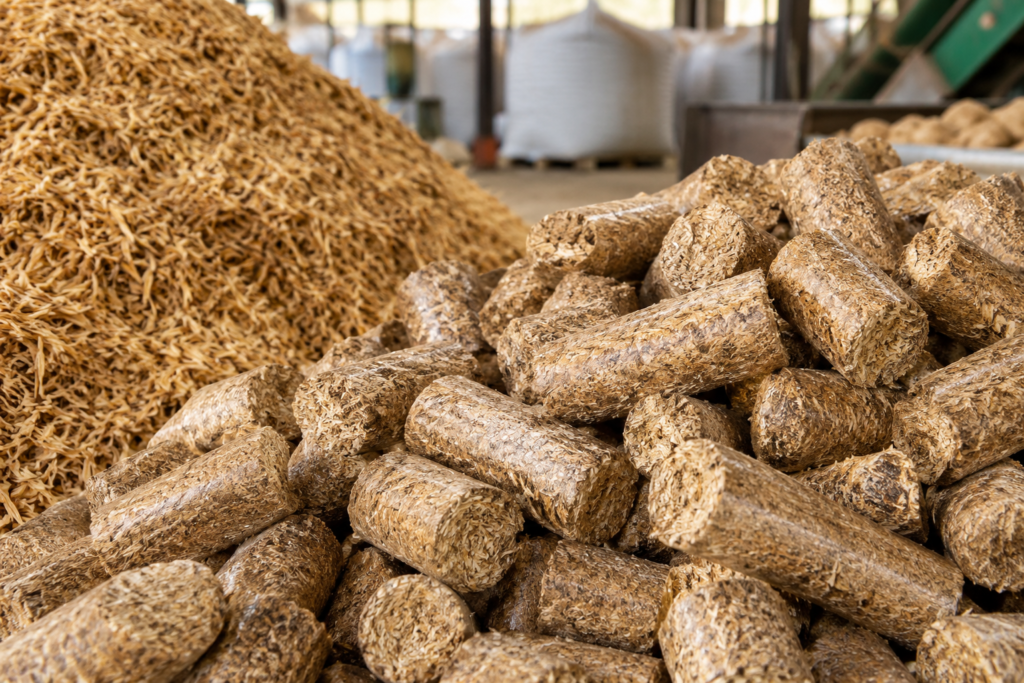
Husk is pelletised by grinding, drying, and pressing through a pellet die. The resulting rice husk pellet has a calorific value of approximately 14–16 MJ/kg and is used primarily for industrial heating in boilers that can tolerate its higher ash content (typically 15–20%), which is considerably higher than wood pellets. European and Asian industrial buyers purchasing rice husk pellets typically use them in dedicated biomass boilers rather than co-firing with coal, where stricter ash limits apply.
Wheat Straw Pellets and Briquettes
Wheat straw is Pakistan’s most abundant crop residue by volume. Conversion to pellets or briquettes requires a drying step because freshly harvested straw has relatively high moisture content. When properly processed, wheat straw pellets reach calorific values of around 14–16 MJ/kg and are competitive on a cost-per-GJ basis against coal in markets with renewable energy incentives.
The limiting factor for wheat straw is the logistical cost of collection from dispersed fields, baling, transport to a processing facility, and drying. Buyers evaluating wheat straw pellets from Pakistan should ask suppliers specifically about their baling and aggregation infrastructure and the proximity of their processing plant to feedstock source areas.
Cotton Stalk Pellets
Cotton stalk — the woody material left standing in cotton fields after picking — has relatively high lignin content compared to cereal straws, which means it pelletises more efficiently and produces a denser, harder pellet. Calorific value is comparable to wheat straw. Cotton-growing districts in Punjab and Sindh are the primary sourcing areas.
Sugarcane Bagasse
Bagasse is the fibrous residue remaining after sugarcane crushing at sugar mills. In Pakistan, sugar mills operate seasonally, concentrating bagasse production into specific months. Bagasse has high moisture content as a fresh residue and requires drying before pelletisation. It is used domestically within sugar mills for co-generation, but surplus is available in some mills. Buyers interested in bagasse-derived products should understand the seasonal nature of supply and the importance of storage and drying capacity at the supplier’s facility.
Wood Waste and Sawdust Pellets
Pakistan’s timber processing and furniture manufacturing sectors generate sawdust, shavings, and offcuts that can be processed into wood pellets meeting ENplus quality grades — the internationally recognised standard for residential and commercial heating pellets. Wood-based pellets have lower ash content than agricultural residue pellets and are preferred by European residential heating markets and Japanese industrial buyers.
Who Is Buying — and Why
Japan and South Korea: Industrial Power Generation
The two largest growth markets for imported biomass in Asia are Japan and South Korea, both driven by policy frameworks that mandate utility-scale renewable energy use.
Japan’s feed-in tariff (FiT) scheme has supported rapid expansion of biomass-fired power capacity. As reported by Argus Media, Vietnamese wood pellet exports to Japan reached 385,000 tonnes in January 2025 alone — up 72% year-on-year — reflecting how quickly demand has grown as new biomass power plants come online. Japan’s annual wood pellet import demand was already at 4.4 million tonnes in 2022 and analysts have projected further growth as additional capacity is commissioned.
South Korea’s Renewable Portfolio Standard (RPS) requires utilities to source a minimum and increasing share of generation from renewable sources, of which biomass pellets are a significant component. South Korea was Vietnam’s second-largest export destination in early 2025.
For a biomass exporter from Pakistan, these markets represent significant volume potential, but they come with strict requirements. Japanese and South Korean buyers typically require sustainability certification (discussed below), long-term supply contracts, consistent quality specifications, and reliable shipping logistics. Pakistan’s geographic position relative to Northeast Asia involves longer shipping routes than Southeast Asian competitors such as Vietnam and Indonesia, which is a cost factor buyers will weigh.
Europe: Industrial Heating and Power Co-firing
Europe remains the world’s largest consumer of biomass for heat and power. The EU’s Renewable Energy Directive drives demand for certified sustainable biomass from utility operators co-firing biomass with coal or burning it in dedicated biomass plants. Countries including the Netherlands, Belgium, Denmark, and the United Kingdom are significant importers.
The European market is highly certification-sensitive. Industrial buyers in Europe typically require Sustainable Biomass Program (SBP) certification for wood-based feedstocks or compliance documentation aligned with the EU’s Renewable Energy Directive sustainability criteria. Agricultural residue products face different certification pathways but must still demonstrate sustainability and greenhouse gas savings relative to fossil fuel baselines.
Regional Markets: Middle East and South Asia
Pakistan’s proximity to Gulf markets makes these a more natural starting point for new exporters. Gulf countries with industrial and manufacturing sectors increasingly use biomass as a fuel for process heating. These markets may have different certification requirements than Europe and Japan, and shorter shipping routes from Pakistan can improve delivered cost competitiveness.
Quality Standards Importers Actually Apply
Understanding what quality specifications international buyers impose is essential before investing in production or seeking export contracts. Different markets have different tolerance levels.
ENplus: The European Residential Standard
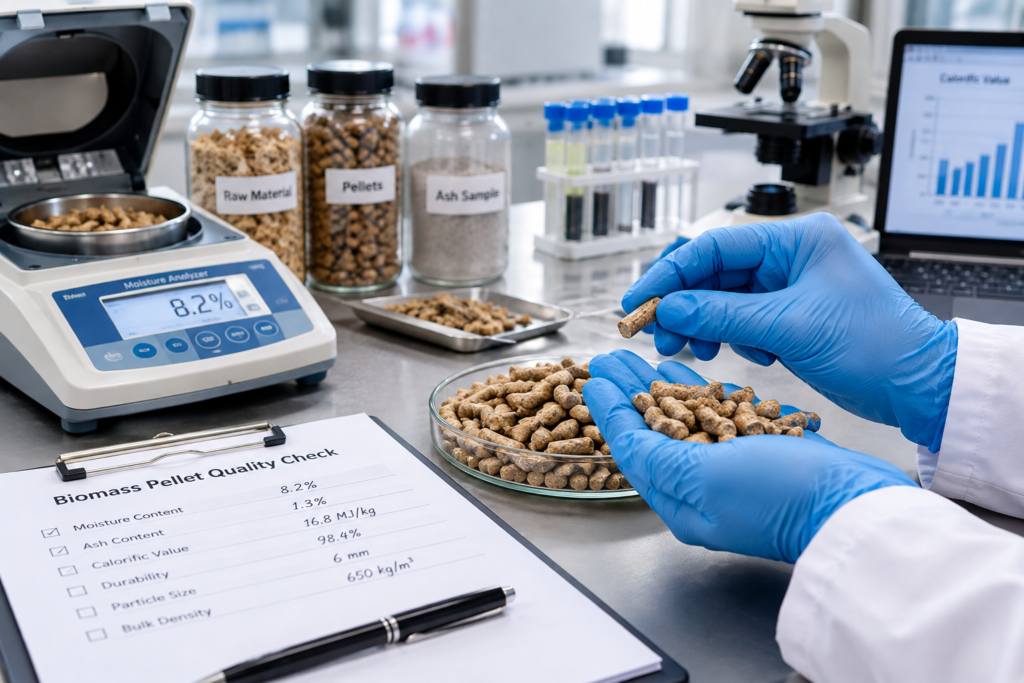
ENplus is the dominant quality certification for pellets sold into European residential and small commercial heating markets. ENplus A1 — the premium grade — requires moisture content below 10%, ash content below 0.7%, and net calorific value above 16.5 MJ/kg. These specifications are achievable with wood-based feedstocks but typically not with agricultural residues, which have higher ash content.
ISO 17225: The International Pellet Classification Standard
ISO 17225 provides a classification framework for solid biofuels including wood pellets, agricultural residue pellets, and blended pellets. It defines categories by moisture, ash content, net calorific value, nitrogen, sulphur, and chlorine content. Buyers in industrial markets — whether in Japan, Korea, or Europe — typically reference ISO 17225 specifications in their procurement contracts. Suppliers must be able to provide third-party laboratory analysis confirming their product meets the contracted specification.
SBP Certification: The Industrial Wood Pellet Standard
The Sustainable Biomass Program (SBP) is the primary sustainability certification scheme for industrial wood pellets traded into European utility markets. It operates on a chain-of-custody model in which pellet mills demonstrate that their feedstock originates from legal and sustainable sources. SBP-certified biomass accounted for a significant share of the EU industrial wood pellet market; as of 2025, the scheme had 405 certificate holders across 35 countries.
For Pakistani suppliers, SBP certification would require a Supply Base Evaluation demonstrating feedstock legality and sustainability, carbon and energy data collection, and third-party audit by an SBP-approved certification body. This is a meaningful investment in time and cost that prospective exporters should budget for when targeting European utility buyers.
Agricultural Residue: Buyer-Specific Specifications
Agricultural residue products such as rice husk pellets, wheat straw pellets, and cotton stalk briquettes are generally traded under buyer-specific specifications rather than a single universal standard. Industrial buyers in Asia and the Middle East typically specify:
- Net calorific value (NCV): Minimum MJ/kg on as-received or air-dried basis
- Moisture content: Maximum percentage
- Ash content: Maximum percentage (critical for boiler compatibility)
- Ash fusion temperature: Determines risk of slagging and fouling in the boiler
- Nitrogen, sulphur, and chlorine content: Emissions compliance
- Particle size and pellet durability: Handling and combustion performance
Suppliers who want to be taken seriously by international buyers should invest in laboratory testing of their product and be able to provide results in a standardised format before a buyer will consider sampling.
Export Documentation and Regulatory Framework
Pakistan’s exports are governed by the Export Policy Order, administered through the Ministry of Commerce. Agricultural biomass residues and processed biomass products are generally freely exportable under Pakistan’s trade regulations — they do not appear on restricted or prohibited lists — but exporters must comply with standard documentation requirements. These include:
- Commercial invoice and packing list
- Bill of lading (for sea freight)
- Certificate of origin issued by the relevant chamber of commerce or TDAP
- Phytosanitary certificate from Pakistan’s Department of Plant Protection (required for unprocessed plant material exported to many countries)
- Quality/laboratory analysis certificate from an accredited testing body
The Trade Development Authority of Pakistan (TDAP) is the primary government body supporting Pakistani exporters, providing market intelligence, facilitating trade missions, and assisting with export documentation. Exporters new to biomass trade should engage TDAP’s Agro and Food Division, which has experience supporting agricultural commodity exporters.
For processed biomass products (pellets, briquettes), the phytosanitary requirements vary by destination country. Some importing countries may waive phytosanitary inspection for processed products that have undergone heat treatment, while others require certification regardless. Exporters must verify the importing country’s specific plant protection requirements before shipping.
Buyers in Japan, South Korea, and the EU may also require documentation demonstrating greenhouse gas savings calculations and sustainability compliance under their domestic renewable energy regulations. These requirements are separate from Pakistani export regulations and must be addressed at the supplier level through appropriate certification schemes.
What to Evaluate When Selecting a Biomass Supplier from Pakistan
For importers and procurement managers conducting supplier due diligence, the following factors deserve careful evaluation beyond price per tonne.
Feedstock control and consistency. Can the supplier demonstrate stable, year-round access to feedstock, or do they depend on spot purchasing from aggregators? Suppliers with long-term agreements with rice mills, sugar mills, or farmer cooperatives are better positioned to maintain supply consistency than those relying on open-market purchases.
Processing infrastructure. Does the supplier operate their own pelletising or briquetting plant, or do they act as a trading intermediary? Buyers should visit or request third-party inspection of the production facility before committing to a container or bulk shipment.
Quality documentation. Reputable suppliers will proactively provide laboratory analysis from an accredited facility for each production batch. If a supplier is unwilling to provide analysis certificates before a commercial order, this warrants caution.
Port and logistics capability. Pakistan’s main export port is Port Qasim near Karachi, which handles bulk agricultural commodity exports. Buyers should ask suppliers about their experience with bulk or container biomass exports, their relationships with freight forwarders experienced in biomass, and realistic lead times from order confirmation to vessel loading.
Sampling protocol. Before committing to a large shipment, buyers should request a product sample and have it independently tested by a laboratory in their own country or by a neutral inspection company. International inspection firms operating in Pakistan — such as SGS, Bureau Veritas, or Intertek — can provide pre-shipment inspection and sampling services.
Minimum quantities and contract structure. Pakistan’s domestic biomass industry is still developing its export capability. Some suppliers may be equipped for container-load quantities while others can commit to Handysize or Panamax bulk vessels. Buyers should be clear about their volume requirements and understand how Pakistani suppliers structure pricing (typically FOB Karachi) before comparing offers.
Pricing Context and Competitive Position
Biomass pricing is primarily driven by energy content (expressed as cost per GJ), logistics costs, and moisture and ash content. Pakistan’s agricultural biomass products — particularly rice husk pellets and wheat straw pellets — are generally cost-competitive on a feedstock cost basis because crop residues are low-cost raw materials and labour costs in Pakistan remain lower than in Southeast Asian competitors.
However, total delivered cost to Northeast Asia or Europe must account for:
- Ocean freight: Pakistan to Japan or South Korea involves longer routing than Vietnam or Indonesia
- Port and handling costs at Karachi: Bulk biomass handling infrastructure is less developed at Pakistani ports than at established biomass export terminals in Southeast Asia
- Processing efficiency: Newer, larger-scale pellet production facilities achieve lower per-tonne processing costs; Pakistan’s industry currently has a mix of facility sizes and ages
Buyers should request FOB pricing and calculate their own landed cost including freight, insurance, port charges at destination, and any import duties applicable in their country. The competitive advantage for Pakistani biomass is most pronounced in Middle Eastern and South Asian markets where freight distances are shorter.
DAA Agri Limited: Agricultural Biomass from Pakistan
DAA Agri Limited is a Pakistan-based agricultural company with interests in biomass products sourced from Pakistan’s crop-producing regions. Buyers seeking a Pakistani contact point for biomass product inquiry or sourcing discussions can reach the company through their website.
Note for readers: Before entering any supply arrangement, buyers should conduct their own due diligence, including facility inspection, product sampling, and independent quality testing, consistent with the standards described in this article.
Frequently Asked Questions
What biomass products can Pakistan export?
Pakistan can supply rice husk pellets, wheat straw pellets and briquettes, cotton stalk pellets, sugarcane bagasse (both raw and pelletised), and wood waste-based pellets from timber processing facilities. The most commercially developed export product at present is rice husk in raw or pelletised form, given its concentration at fixed milling sites. Wheat straw and cotton stalk products require more developed collection and processing infrastructure.
Which countries import biomass from Asian suppliers?
Japan and South Korea are the largest industrial biomass importers in Asia, driven by renewable energy mandates. European countries — particularly the Netherlands, Belgium, Denmark, and the UK — import significant quantities for power generation and industrial heating. Middle Eastern markets are emerging buyers. The specific product requirements, sustainability certifications, and quality specifications differ by destination country.
What quality certifications do biomass buyers typically require?
For wood-based pellets sold into European utility markets, SBP (Sustainable Biomass Program) certification is the dominant standard. ENplus certification applies to residential and small commercial heating pellets. ISO 17225 provides the technical classification framework used in most commercial contracts. Agricultural residue products are often traded under buyer-specific specifications rather than a single certification scheme, though sustainability documentation aligned with the EU Renewable Energy Directive is increasingly required for European buyers.
Is Pakistani biomass phytosanitary-certified for export?
Pakistan’s Department of Plant Protection issues phytosanitary certificates for plant-based export products. Requirements vary by destination country — some importing countries require certification for all plant material while others exempt processed products that have undergone heat treatment during pelletisation. Exporters must verify the specific requirements of the importing country before shipping.
What are the main challenges for biomass exporters in Pakistan?
The primary challenges are: inconsistent feedstock aggregation infrastructure outside of fixed processing sites like rice mills; variable moisture content in field residues requiring drying investment; limited experience with the certification schemes required by European and Northeast Asian buyers; and longer ocean freight distances to Northeast Asian markets compared to Southeast Asian competitors. Suppliers addressing these challenges systematically — through investment in processing capacity, third-party quality assurance, and certification — are better positioned to compete in international markets.
How should buyers evaluate a new biomass supplier from Pakistan?
Start with documented product specifications and laboratory analysis. Request a sample for independent testing before committing to commercial quantities. Ask specifically about feedstock source, processing infrastructure, and export history. Engage an international inspection company such as SGS, Bureau Veritas, or Intertek for pre-shipment inspection on first orders. Visit the production facility if the order volume justifies it.
Conclusion
Pakistan’s biomass export potential is real but still in an early stage of development as a commercial export industry. The feedstock base is substantial — particularly rice husk, wheat straw, and cotton stalk — and pricing can be competitive in regional markets and, for the right product specifications, in more distant markets where sustainability and energy policy are driving demand.
International buyers evaluating Pakistan as a biomass sourcing origin should approach it methodically: understand the specific product characteristics available, apply the same quality and sustainability standards they would apply to any supplier, and invest in supplier due diligence before committing significant volumes.
For buyers ready to explore what Pakistani biomass products could contribute to their supply programme, DAA Agri Limited welcomes sourcing enquiries and supply discussions.
Turn industry knowledge into a supply conversation.
Contact GreenCore for product availability, specifications, bulk packaging and export support.