
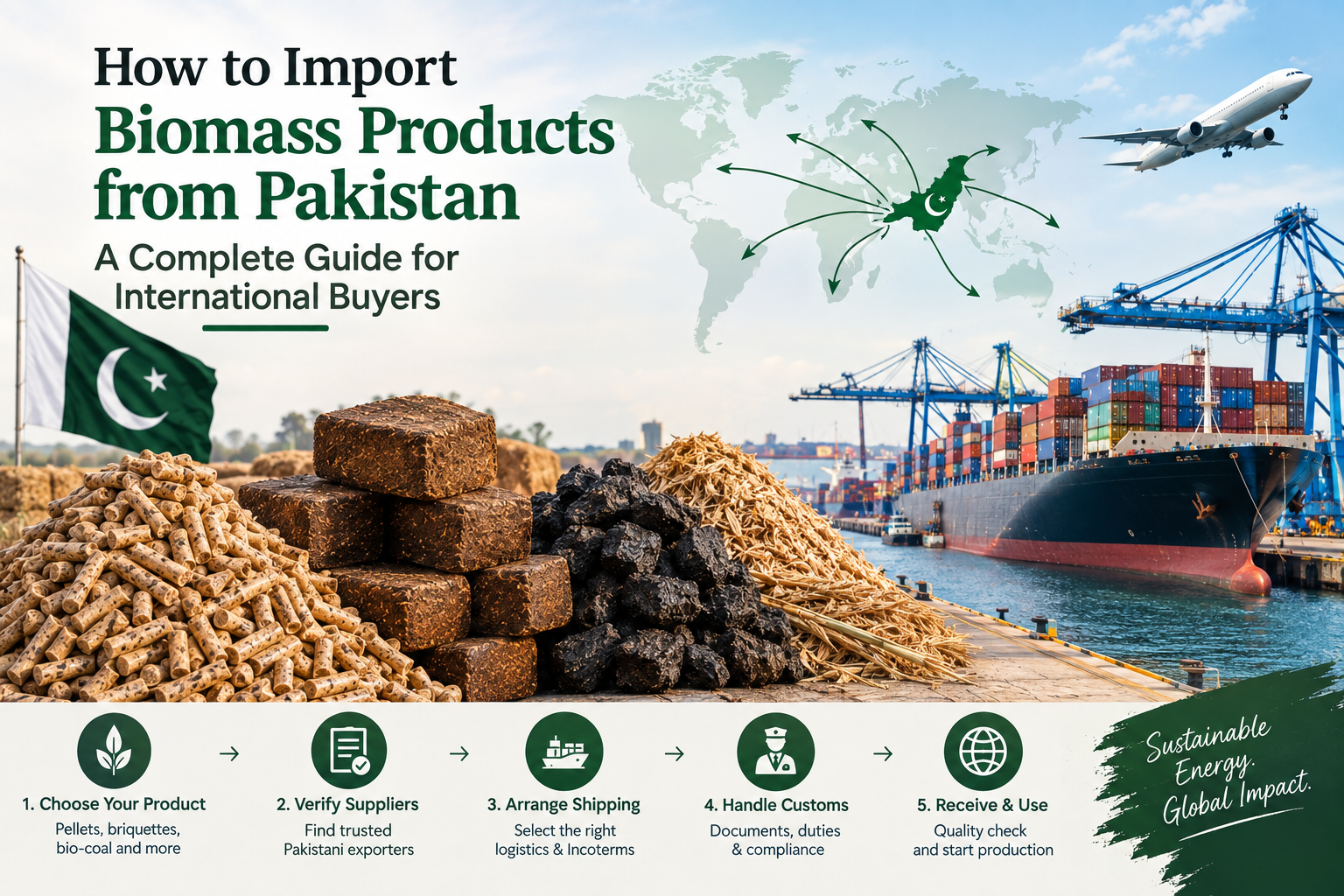
How to Import Biomass Products from Pakistan: A Complete Guide for International Buyers
Pakistan is one of the most agriculturally productive countries in Asia, generating enormous volumes of crop residues and organic by-products […]
Pakistan is one of the most agriculturally productive countries in Asia, generating enormous volumes of crop residues and organic by-products […]
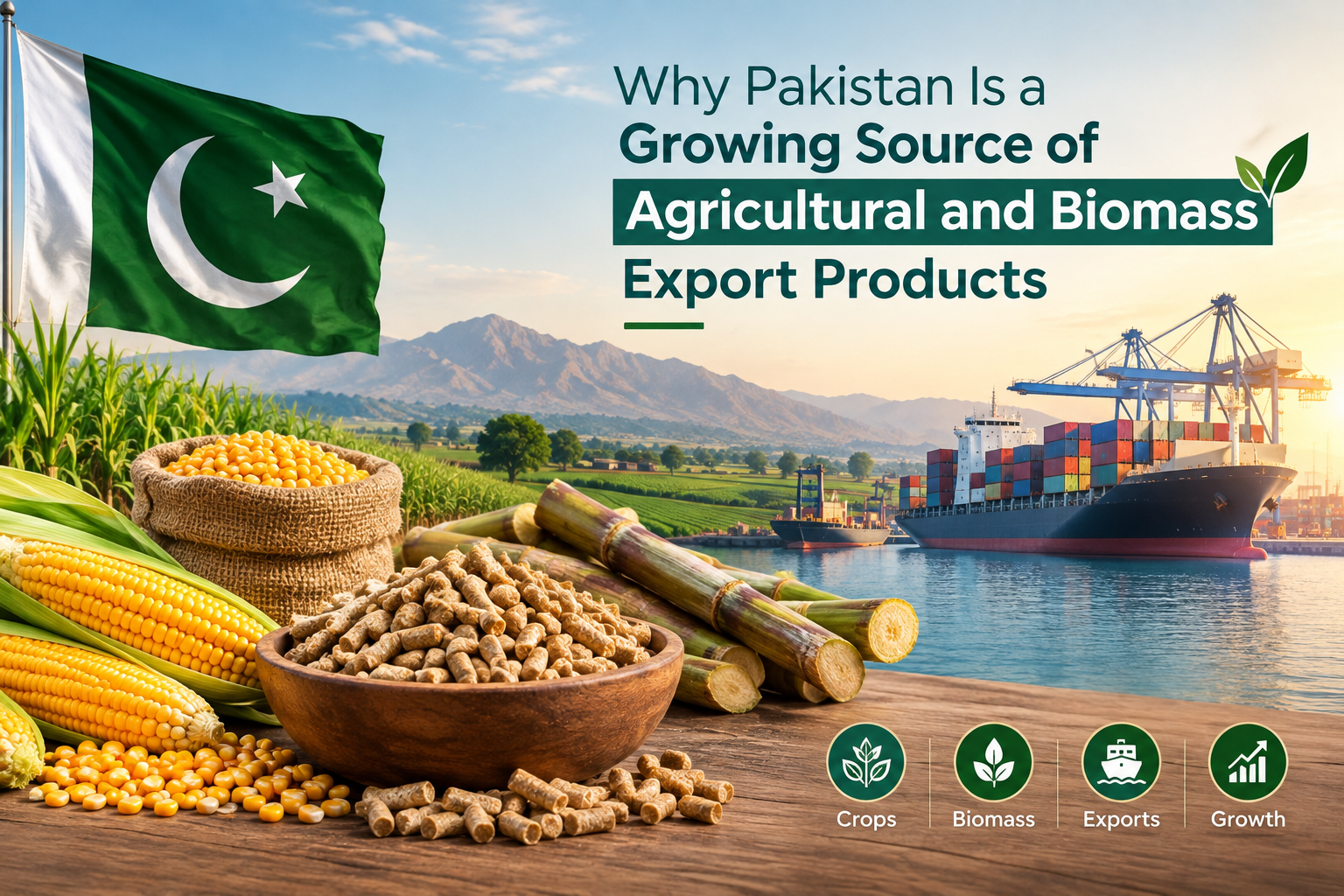
Pakistan is one of the most agriculturally productive countries in Asia, generating enormous volumes of crop residues and organic by-products every year. For energy companies, industrial processors, and sustainability-focused procurement teams, this creates a reliable and cost-effective source of raw biomass — from rice husk and cotton stalks to bagasse and wheat straw.
This guide, How to Import Biomass Products from Pakistan, is written for procurement managers, importers, and distributors who are evaluating Pakistan as a biomass sourcing destination. It covers what products are available, how the export process works, what documentation you will need, and what to evaluate before placing an order with a Pakistani biomass supplier.
Pakistan’s Biomass Supply Base: What’s Available and Why It Matters
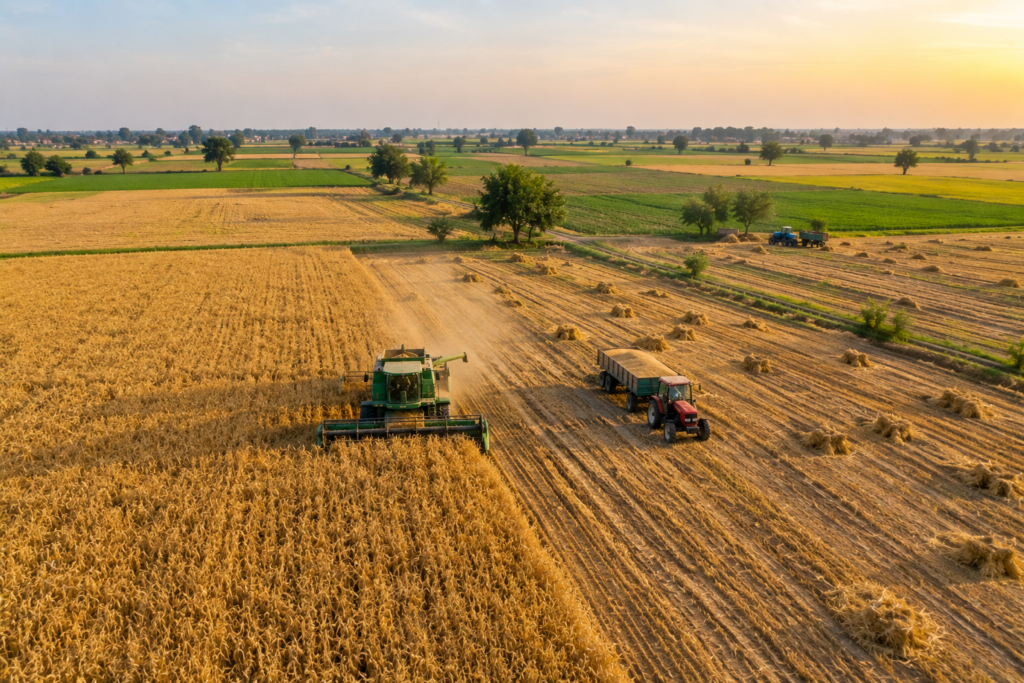
Pakistan’s economy depends heavily on agriculture, and that footprint generates a substantial annual supply of biomass feedstock. According to the World Bank’s Energy Sector Management Assistance Program (ESMAP), the country produces significant volumes of wheat straw, cotton stalks, rice husk, rice straw, maize stalk, sugarcane bagasse, and maize cob — all mapped and quantified at the district level across the country.
The major biomass products available for export include:
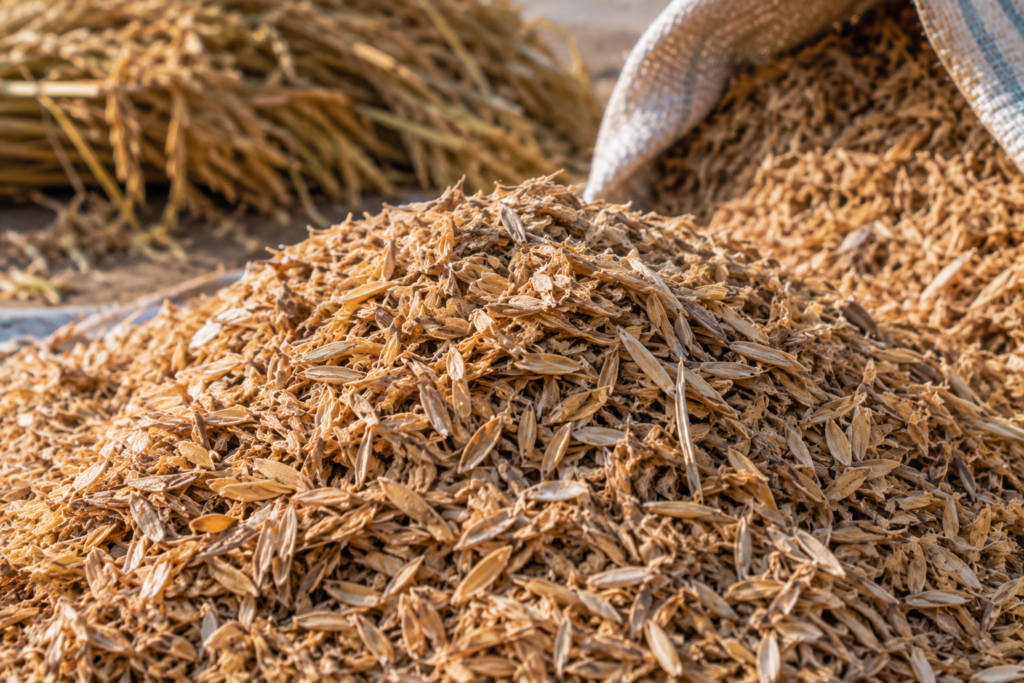
Rice husk — Generated in large volumes from Pakistan’s rice milling industry. Pakistan is consistently among the world’s top rice exporters, which means rice mills operate at scale in Punjab and Sindh, producing husk as a continuous by-product. Rice husk has a calorific value suitable for use in boilers and power generation, and its high silica content also makes it useful in industrial and construction applications.
Cotton stalks — Pakistan is one of the world’s largest cotton producers. After harvest, cotton stalks are widely available across Punjab and Sindh. They are used as biomass fuel in brick kilns, industrial boilers, and briquette production. Cotton stalks can also be densified into pellets for higher-value energy applications.
Sugarcane bagasse — Generated as a residue from Pakistan’s 80+ sugar mills. Bagasse has a well-established role in cogeneration, where sugar mills run turbines during the milling season. Surplus bagasse is available for sale to external buyers, particularly during and after the milling period.
Wheat straw — One of the most abundant crop residues in the country, wheat straw is used as animal feed domestically, but exportable volumes exist. Buyers should note that domestic demand for this material can fluctuate depending on livestock industry cycles.
Maize cobs and stalks — Available in Punjab and KPK, maize residues are suitable for biochar production, direct combustion, and animal feed applications.
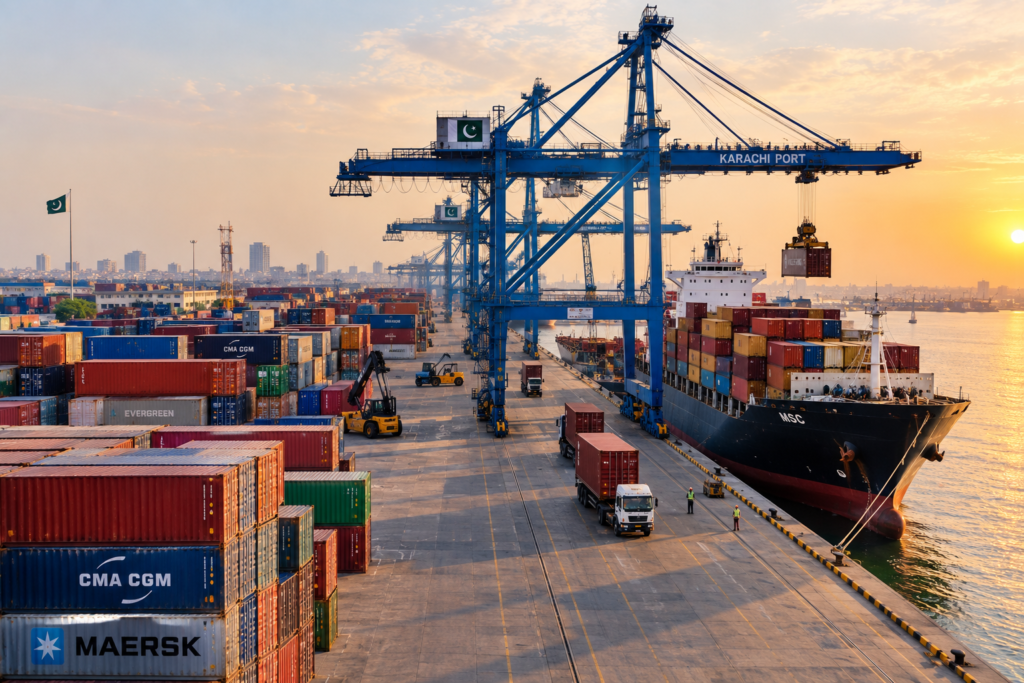
For buyers comparing sourcing origins, Pakistan’s geographic position means sea freight via Karachi to European, Middle Eastern, and Southeast Asian destinations is reasonably well-served by major shipping lines.
Understanding the HS Code Classification for Biomass Imports
Before engaging suppliers, buyers need to understand how biomass products are classified in international trade. Getting the HS code right affects import duties in your country, documentation requirements, and how customs authorities classify the shipment.
The primary biomass categories relevant to Pakistan exports fall under:
- HS 1213 — Cereal straw and husks (unprepared, whether or not chopped, ground, pressed, or in pellet form). This covers rice husk, wheat straw, and similar materials.
- HS 4401 — Fuel wood, wood residues, and sawdust in logs or compressed forms (relevant for biomass briquettes and pellets made from agricultural residues).
- HS 2302 — Bran, sharps, and other residues of milling operations (may apply to certain processed biomass products).
Buyers should verify the exact classification with their own customs authority or a licensed customs broker before importing, as national tariff schedules can differ from the WTO harmonized system at the 8-digit level.
The Export Process from the Pakistani Side
Understanding how your supplier is required to operate makes it easier to ask the right questions and assess their capability.
Pakistani exporters must work through the Trade Development Authority of Pakistan (TDAP), which is the central government body supporting exporters. Agricultural commodity exporters typically need to be registered with the relevant trade body, and shipments require standard export documentation.
Buyers should ask their Pakistani supplier to provide:
Commercial Invoice — Showing buyer and seller details, product description, quantity, agreed price per unit, and the Incoterm being used (typically FOB Karachi or CIF destination port).
Packing List — Itemising the contents of each container or batch, with weights, dimensions, and package markings.
Bill of Lading — Issued by the carrier once the shipment has been loaded. This is the key document for taking possession of goods at the destination port.
Certificate of Origin — Confirming the goods originate from Pakistan. This may qualify for preferential tariff treatment depending on the importing country’s trade arrangements with Pakistan.
Phytosanitary Certificate — Required for most plant-based agricultural materials crossing international borders. It is issued by Pakistan’s Department of Plant Protection and confirms the product is free from regulated pests and diseases. Most importing countries will require this for raw biomass.
Quality or Specification Certificate — For buyers with specific calorific value, moisture content, or ash content requirements, a third-party quality report from a recognised laboratory is strongly advisable.
Buyers importing into the European Union should also be aware of the EU’s Renewable Energy Directive (RED II), which sets sustainability criteria for biomass used in energy generation. If you are sourcing biomass for a regulated energy application, your supplier needs to be able to document the supply chain and land-use compliance. This is a growing compliance area and worth raising directly with your supplier before placing an order.
What to Evaluate Before Placing an Order
The gap between a supplier’s quotation and the product that arrives at your port can be significant if quality parameters are not agreed upon in writing. Here is what experienced biomass importers typically lock down before committing to a purchase.
Moisture Content
Moisture is one of the most commercially important specifications in biomass. Higher moisture content means lower effective calorific value per tonne, and the buyer ends up paying for water weight. Agree on a maximum moisture percentage and specify that this will be verified by an independent inspection at the point of loading.
For rice husk, moisture below 14% is generally acceptable for industrial fuel applications. For cotton stalks and wheat straw intended for pelleting or direct combustion, most buyers require moisture below 15–18% depending on the end use.
Calorific Value
If you are purchasing biomass for energy generation or co-firing, specify the net calorific value (NCV) you require, expressed in MJ/kg or kcal/kg. Ask the supplier for laboratory test reports from previous shipments and whether they can arrange testing by a third party such as SGS or Bureau Veritas before shipment.
Ash Content and Contamination
High ash content reduces combustion efficiency and creates more residue to manage. Agricultural biomass varies in ash content depending on the crop type and how the material was collected. Rice husk typically has a higher ash content than cotton stalk, largely due to its silica structure. If ash content matters for your application, specify it in your purchase contract.
Also ask about contamination — stones, soil, and foreign material mixed into bulk biomass are a common source of disputes, particularly when material is collected directly from fields rather than processed at a central facility.
Packaging and Logistics
Bulk biomass from Pakistan is generally shipped either loose in 20-foot or 40-foot containers, in jumbo bags (also called bulk bags or FIBCs), or as compressed bales. The format affects how the product loads, how it behaves during transit, and how you receive and handle it at your end.
If you are purchasing rice husk in pellet form rather than raw husk, packaging in PP woven bags is common. Confirm the bag weight, stacking specification, and container utilization rate with your supplier.
Minimum Order Quantities and Lead Times
Raw biomass from Pakistan is typically sold in container loads or in multi-container consignments. Lead times depend on whether the supplier is holding stock or sourcing against your order. Seasonal availability matters — cotton stalk, for example, is most plentiful post-harvest (October to December in Punjab). If your sourcing timeline does not align with peak availability, discuss this with your supplier early.
Finding a Reliable Biomass Supplier in Pakistan
Pakistan has a functioning network of agricultural commodity exporters, but the biomass sector is less formalised than, say, Pakistan’s basmati rice or cotton textile industries. This means supplier quality varies more than buyers might expect.
Several approaches work well for identifying credible suppliers:
Trade facilitation bodies — TDAP maintains a directory of registered Pakistani exporters. For biomass specifically, buyers can also look at the Pakistan Single Window platform, which has digitalised export documentation and provides visibility into registered exporters.
Trade exhibitions and B2B platforms — International agricultural trade shows and B2B platforms list Pakistani suppliers, though buyers should verify credentials independently before proceeding.
Third-party inspection prior to shipment — Regardless of how you find a supplier, arranging pre-shipment inspection through an independent body (SGS, Bureau Veritas, Intertek) is strongly advisable for first shipments. This gives you an independent assessment of the product quality, moisture, and weight before the cargo leaves Pakistan.
Sample orders — Most established exporters can ship a representative sample before a full container order. If a supplier declines to provide samples or cannot produce a quality test report for their material, that warrants caution.
Daa Agri Limited supplies biomass products sourced from Pakistan’s agricultural sector for international buyers. If you are evaluating Pakistani suppliers for your procurement requirements, their team can provide product information and discuss your sourcing needs directly.
Payment Terms and Trade Risk
For first-time biomass imports from Pakistan, buyers often prefer documentary credit (Letter of Credit, or LC) as it provides protection on both sides — the seller is assured of payment, the buyer retains the ability to verify documents before funds are released. Established relationships often shift to Telegraphic Transfer (TT) with a partial advance, which is simpler to administer.
If you are working with a Pakistan-based supplier for the first time, it is worth discussing payment structure openly at the quotation stage. A supplier who is reluctant to work with LC terms for a first order is worth asking about directly.
Importing Biomass into the EU, UK, and Other Key Markets
Regulatory requirements for biomass imports vary significantly by destination market. A few considerations worth highlighting:
European Union — Under the EU Renewable Energy Directive, biomass used for energy purposes must meet sustainability criteria related to greenhouse gas savings and land use. For non-energy applications (animal feed, industrial use), standard import documentation applies. The EU also requires a phytosanitary certificate for most plant-based materials from third countries.
United Kingdom — Post-Brexit, the UK has its own import requirements. DEFRA regulates plant material imports, and biomass for energy must comply with the UK’s Renewables Obligation or Contracts for Difference sustainability requirements, depending on the end application.
UAE and Middle East — The Gulf markets have fewer regulatory barriers for biomass imports and are a natural market for Pakistani suppliers given proximity and established trade routes.
China — China’s biomass import requirements have tightened in recent years, with phytosanitary inspection at ports of entry being thorough. Buyers sourcing for Chinese facilities should confirm with their import agent what certifications are currently required.
Buyers are advised to verify current import requirements with their own customs authority or a licensed trade advisor before finalising any purchase, as regulations change.
Frequently Asked Questions
What types of biomass products does Pakistan export?
The most commonly exported biomass materials from Pakistan include rice husk, cotton stalks, wheat straw, sugarcane bagasse, and maize cobs. Some suppliers also export these materials in processed or compressed forms such as pellets or briquettes.
Do I need a phytosanitary certificate to import biomass from Pakistan?
In most cases, yes. Plant-based biomass materials are subject to phytosanitary regulations in most importing countries. A phytosanitary certificate issued by Pakistan’s Department of Plant Protection confirms the material is free from regulated pests. Buyers should verify the specific requirements of their own country’s plant health authority.
What is the HS code for rice husk from Pakistan?
Rice husk and similar cereal husks generally fall under HS code 1213 (cereal straw and husks). Buyers should confirm the precise 8-digit classification with a licensed customs broker in their country, as tariff schedules differ at the national level.
How can I verify the quality of biomass before it leaves Pakistan?
The most reliable method is to arrange pre-shipment inspection through an independent organisation such as SGS, Bureau Veritas, or Intertek. Request the inspection to cover moisture content, calorific value, ash content, and visual inspection for contamination. Ask your supplier for laboratory test reports from previous consignments as a starting point.
What payment terms are typical for biomass imports from Pakistan?
First shipments commonly use documentary credit (Letter of Credit) for buyer protection. Ongoing relationships often move to partial advance plus balance against shipping documents. Discuss payment structure with your supplier before finalising the contract.
Is biomass from Pakistan eligible for any preferential import tariffs?
Pakistan benefits from Generalised System of Preferences (GSP+) status in the European Union, which provides preferential tariff treatment for eligible products. Whether specific biomass HS codes are covered depends on the importing country’s tariff schedule. A customs broker or trade advisor can confirm eligibility for your specific product and destination.
Ready to Source Biomass from Pakistan?
Daa Agri Limited works with international buyers seeking reliable Pakistani biomass supply. If you are evaluating rice husk, cotton stalks, or other agricultural biomass materials for your procurement program, we can discuss specifications, logistics, and sourcing timelines with you directly.
Visit Daa Agri Limited to learn more about their product offering or to discuss your requirements.
Turn industry knowledge into a supply conversation.
Contact GreenCore for product availability, specifications, bulk packaging and export support.