
Biomass Briquettes vs Bio-Coal: Which Sustainable Fuel Is Better?
Pakistan’s industrial boilers, brick kilns, and textile units burn through a lot of fuel every winter, and a growing share […]
Pakistan’s industrial boilers, brick kilns, and textile units burn through a lot of fuel every winter, and a growing share […]
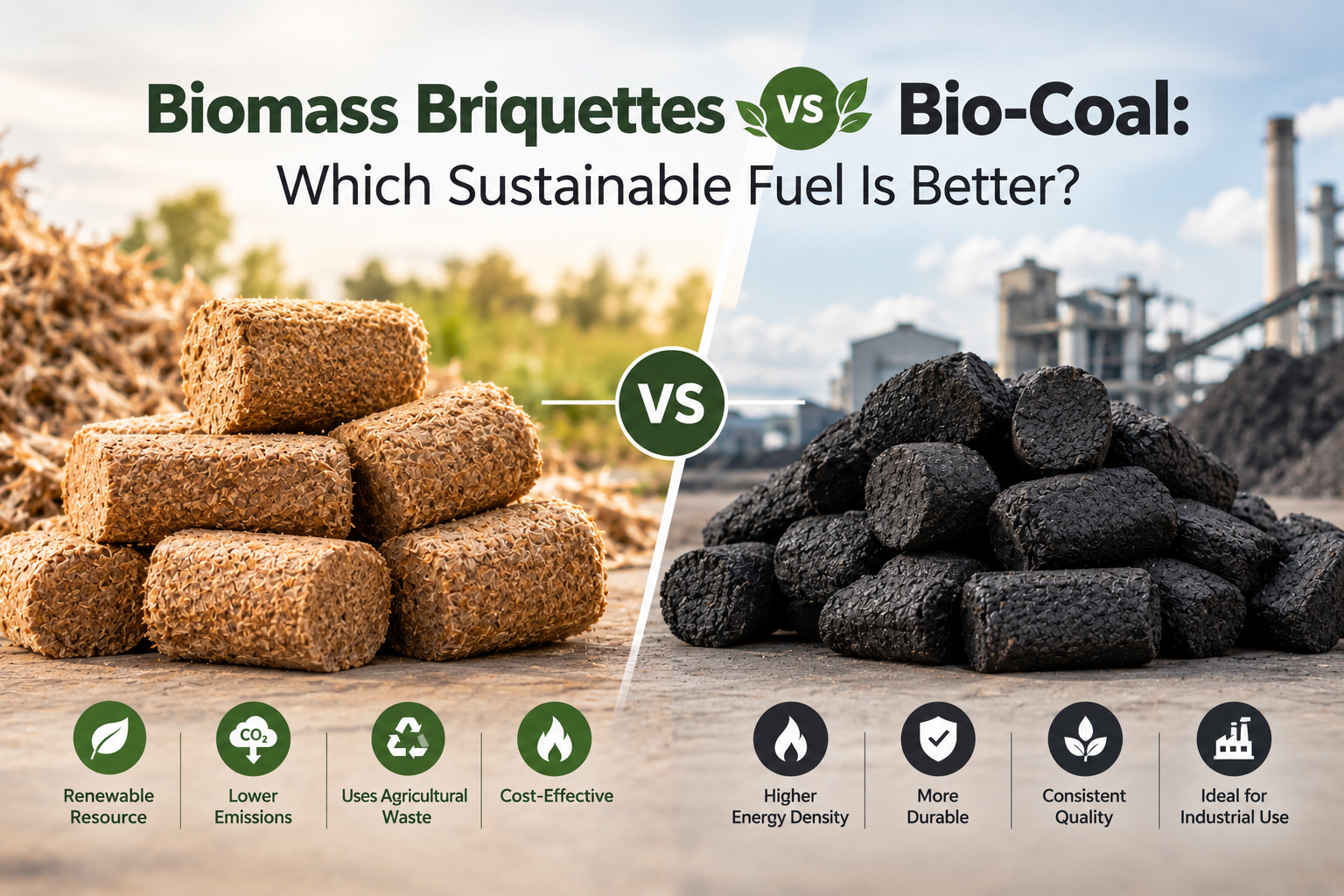
Pakistan’s industrial boilers, brick kilns, and textile units burn through a lot of fuel every winter, and a growing share of buyers are asking the same question: Biomass Briquettes vs Bio-Coal: Which Sustainable Fuel Is Better? The two terms get used almost interchangeably in casual conversation, but they are not the same product; they don’t perform the same way in a furnace, and they don’t suit the same buyer.
This matters more in Pakistan than in most places. The country imports roughly 19 million tonnes of coal a year at a cost exceeding $2.5 billion, according to reporting on a recent UK-backed bio-coal demonstration project in South Punjab, while millions of tonnes of crop residue — cotton stalks, sugarcane waste, rice husk — get burned in open fields every season instead of being put to use. That combination of expensive imported fuel and wasted agricultural residue is exactly why briquette and bio-coal producers have started scaling up locally.
This article breaks down what each fuel actually is, how they differ in composition and performance, and what a procurement manager, brick kiln operator, or industrial buyer should actually weigh before switching.
What Are Biomass Briquettes?
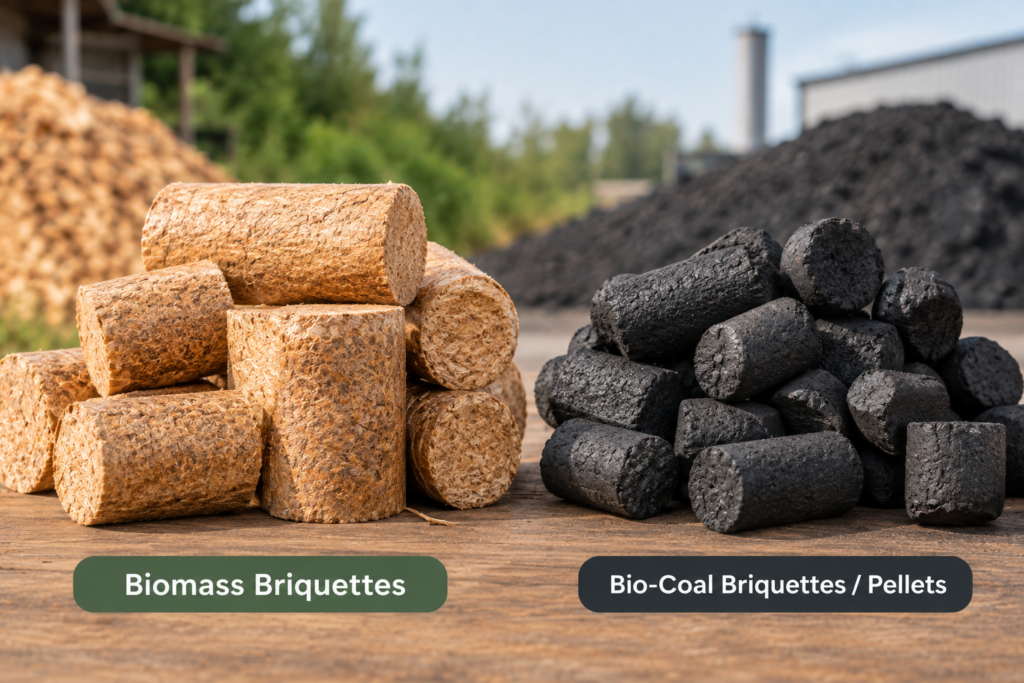
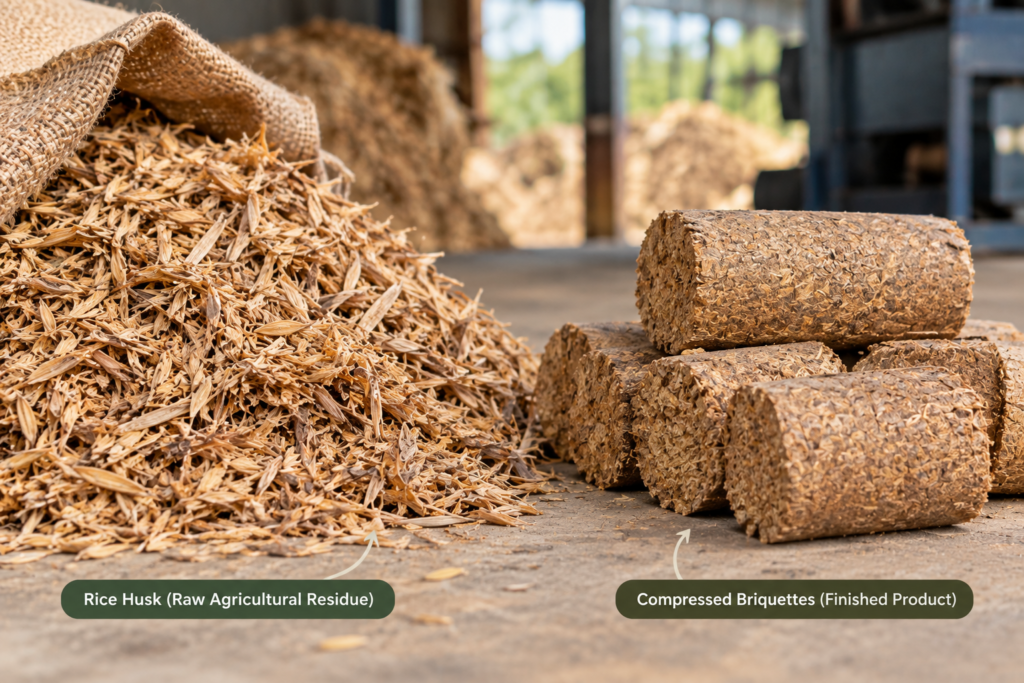
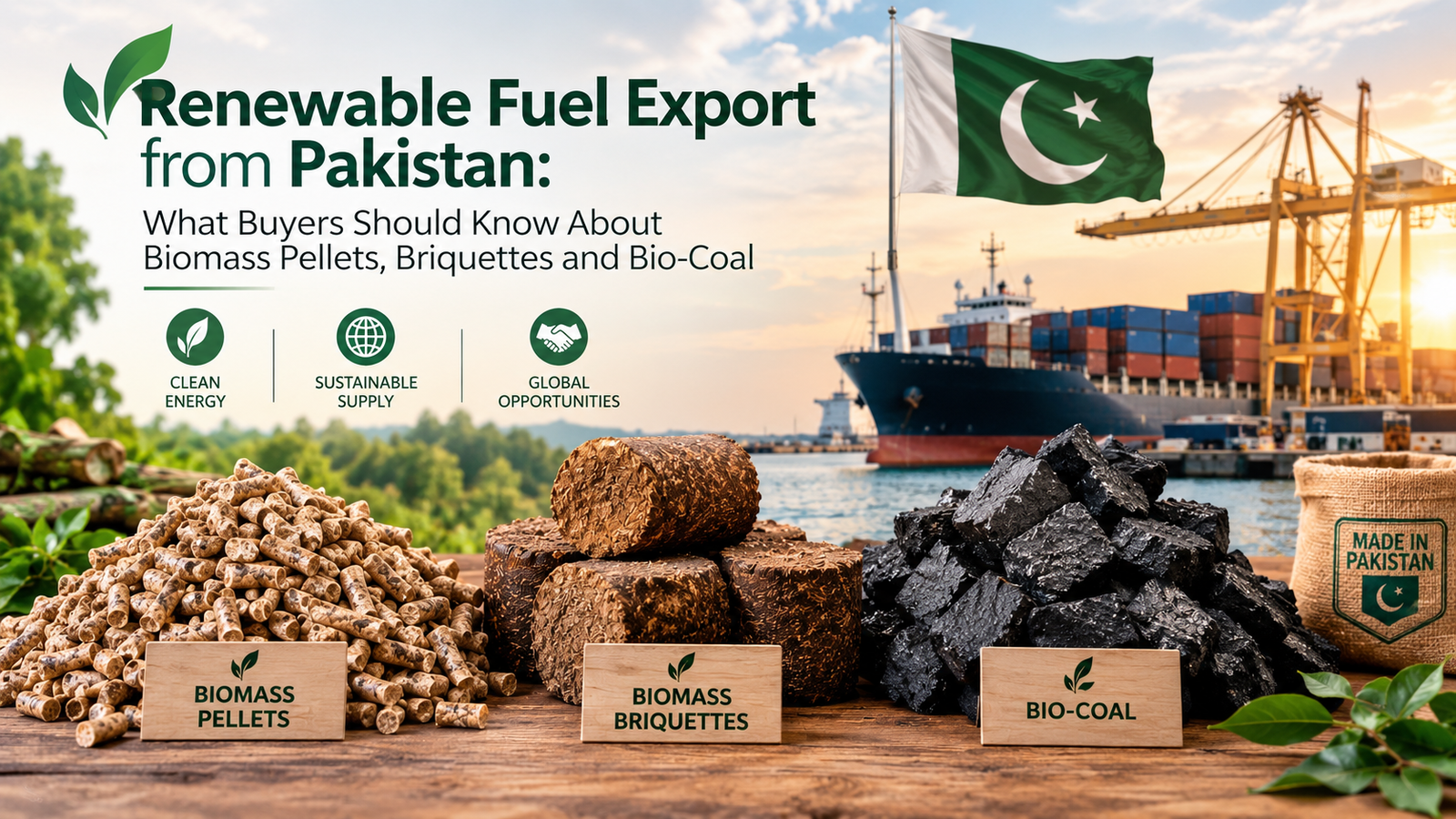
Biomass briquettes are made entirely from organic material — agricultural residues like rice husk, cotton stalks, sugarcane bagasse, or wood waste — compressed under high pressure into dense blocks, usually with no coal content at all. No binder is typically needed; the pressure and heat generated during compression are usually enough to bind the natural lignin in the plant material and hold the briquette together.
Because they’re 100% organic, biomass briquettes burn cleaner in terms of sulfur content, and they’re generally considered carbon-neutral over their lifecycle, since the CO2 released during combustion roughly matches what the original plants absorbed while growing. Their calorific value typically falls somewhere in the range of 3,500 to 4,500 kcal/kg depending on the feedstock and moisture content, which is lower than most coal grades but still workable for a wide range of boiler and furnace applications.
The tradeoff is that pure biomass briquettes burn faster and can be less energy-dense than coal, meaning a boiler operator may need to feed more material, more often, to hit the same heat output.
What Is Bio-Coal?
Bio-coal — sometimes called a biocoal briquette or biobriquette — is a blended fuel, not a pure biomass product. Research published on biobriquette composition describes it as typically consisting of 70 to 85 percent coal by weight, blended with 15 to 30 percent biomass such as sawdust, bagasse, rice husk, or bark. The biomass component is mixed in specifically to reduce the sulfur and ash output of the coal while retaining most of coal’s higher energy density.
A separate line of bio-coal production, gaining attention in Pakistan specifically, skips coal altogether and instead uses torrefaction — a controlled heating process that partially carbonizes raw crop residue without burning it — to produce an engineered fuel that behaves like coal but starts as 100% agricultural waste. This is the approach behind a new UK-funded facility being built at the University of Kamalia in South Punjab, which is designed to convert cotton stalk and sugarcane residue into bio-coal pellets intended as a direct substitute for imported coal in brick kilns and textile mill boilers, at an estimated 40 to 50 percent lower cost.
So when someone in Pakistan says “bio-coal,” they could mean either a coal-biomass blend or a fully residue-based torrefied fuel — it’s worth clarifying which one a supplier is actually offering before you buy.
[
Biomass Briquettes vs Bio-Coal: The Practical Differences
Energy Content and Burn Behavior
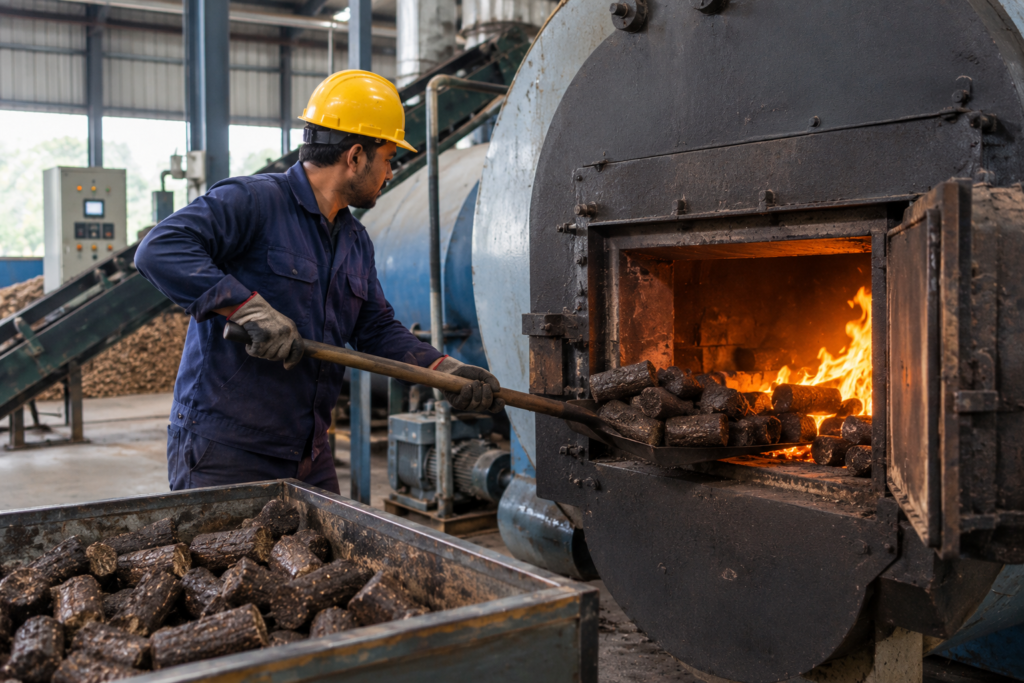
Coal-blended bio-coal generally holds a higher and more consistent calorific value than pure biomass briquettes, because coal itself has a denser carbon structure. A pure biomass briquette burns hotter initially but for a shorter overall duration per kilogram. At the same time, a coal-biomass blend tends to sustain heat output over a longer burn cycle — which matters for continuous industrial processes like brick firing that need steady temperatures for extended periods.
Torrefied, coal-free bio-coal sits somewhere in between: the torrefaction process increases energy density compared to raw biomass, closing some of that performance gap without reintroducing fossil coal.
Emissions and Ash
This is where pure biomass briquettes usually have a clear edge. Studies on agricultural residue briquettes commonly report ash content below 5% and low sulfur emissions, since there’s no coal component contributing sulfur or heavy ash residue. Coal-blended bio-coal reduces emissions compared to raw coal, but doesn’t eliminate them the way a pure biomass product does — the improvement scales with how much biomass is in the blend.
For buyers operating under environmental compliance pressure, or supplying to industries where emissions are monitored, that distinction is often the deciding factor rather than price.
Cost and Availability
Coal-blended bio-coal has been a more established product in South Asia for longer, so supply chains and machinery for producing it are more mature in some regions. Pure biomass briquetting, by contrast, has had strong grassroots momentum in Pakistan specifically — training programs run through organizations like ICIMOD have supported local bio-briquette production in Khyber Pakhtunkhwa and Gilgit-Baltistan for household and small-enterprise use, which has helped build local feedstock and production know-how in those regions.
Coal-free torrefied bio-coal is the newest of the three approaches and is still moving from pilot to commercial scale in Pakistan. However, the economics look promising: the demonstration project in Punjab projects roughly 40 to 50 percent savings versus imported coal once at commercial volume.
Feedstock Dependence
Biomass briquette quality depends heavily on the consistency of the feedstock — moisture content, particle size, and the specific crop residue used all affect the final calorific value and how well the briquette holds together during transport. Buyers sourcing briquettes should ask suppliers what feedstock blend they use and whether it’s consistent across batches, since a supplier switching feedstocks seasonally (say, from rice husk to cotton stalk) can shift performance from one shipment to the next.
Bio-coal blends are somewhat more forgiving on this front because the coal component provides a stable baseline, with biomass playing a smaller, supporting role in the mix.
Which One Should a Buyer Choose?
There isn’t a single correct answer — it depends on what the fuel is being used for.
- If emissions compliance or a fully renewable fuel claim matters (for export-facing manufacturers, or industries facing environmental audits), pure biomass briquettes are generally the stronger fit, since they contain no fossil coal at all.
- If sustained, high-temperature heat over long burn cycles is the priority — brick kilns are the classic example — a coal-biomass bio-coal blend, or an engineered torrefied bio-coal, tends to perform closer to what operators are used to from straight coal.
- If reducing import dependence and total fuel cost is the main driver, both options help, but Pakistan-specific projects converting local crop residue into bio-coal are specifically being built around 40–50% cost savings versus imported coal, which is worth investigating for anyone with high-volume, steady fuel demand.
Whichever direction a buyer leans, the same questions apply to any supplier: What is the exact feedstock and blend ratio? What’s the calorific value and ash content on a per-batch basis, not just as an average? Is testing data available, and how is moisture content controlled during storage and transport? A supplier that can answer these clearly, with actual test figures rather than general marketing claims, is usually a more reliable long-term partner than one offering the lowest price with no documentation.
FAQs
Is bio-coal the same as biomass briquettes?
No. Bio-coal is most commonly a blend of coal (typically 70–85%) and biomass (15–30%), while biomass briquettes are made entirely from organic material with no coal content. Some newer bio-coal products in Pakistan use torrefaction to make a coal-free fuel from crop residue, so it’s worth confirming which type a supplier means.
Which fuel burns hotter, biomass briquettes or bio-coal?
Coal-blended bio-coal generally has a higher calorific value than pure biomass briquettes because coal is more energy-dense. Torrefied, coal-free bio-coal typically falls between raw biomass and coal-blended bio-coal in energy content.
Are biomass briquettes considered a renewable fuel in Pakistan?
Yes, biomass briquettes made from agricultural residue are considered a renewable, largely carbon-neutral fuel source, and their production has been supported through rural training and development programs in parts of Khyber Pakhtunkhwa and Gilgit-Baltistan.
Why is bio-coal gaining attention in Pakistan specifically?
Pakistan imports a large volume of coal annually at high cost, while a large amount of agricultural residue is burned in open fields each year rather than used productively. Converting that residue into bio-coal addresses both the import cost and the seasonal crop-burning problem at once, which is why new processing facilities are being developed in Punjab.
Can biomass briquettes fully replace coal in industrial boilers?
In many boiler and furnace setups, yes, though operators may need to adjust feed rates since biomass briquettes typically have a lower calorific value than coal. Some industrial users choose a coal-biomass bio-coal blend as a transitional step rather than switching to 100% biomass immediately.
Final Thoughts
Biomass briquettes and bio-coal both convert agricultural waste into usable fuel, but they solve slightly different problems — one prioritizes being fully renewable and low-emission, the other prioritizes matching coal’s heat output and burn duration more closely. The right choice comes down to what your process actually needs: emissions performance, sustained heat, cost savings, or some balance of all three.
If you’re evaluating sustainable fuel options for your operation, you can learn more about DAA Agri Limited and get in touch to discuss your specific fuel requirements.
Turn industry knowledge into a supply conversation.
Contact GreenCore for product availability, specifications, bulk packaging and export support.