
From Agricultural Residues to Export Products: Pakistan’s Biomass Supply Chain
Every wheat harvest in Punjab leaves behind straw. Every rice mill in Sindh produces husk by the truckload. Every sugar […]
Every wheat harvest in Punjab leaves behind straw. Every rice mill in Sindh produces husk by the truckload. Every sugar […]
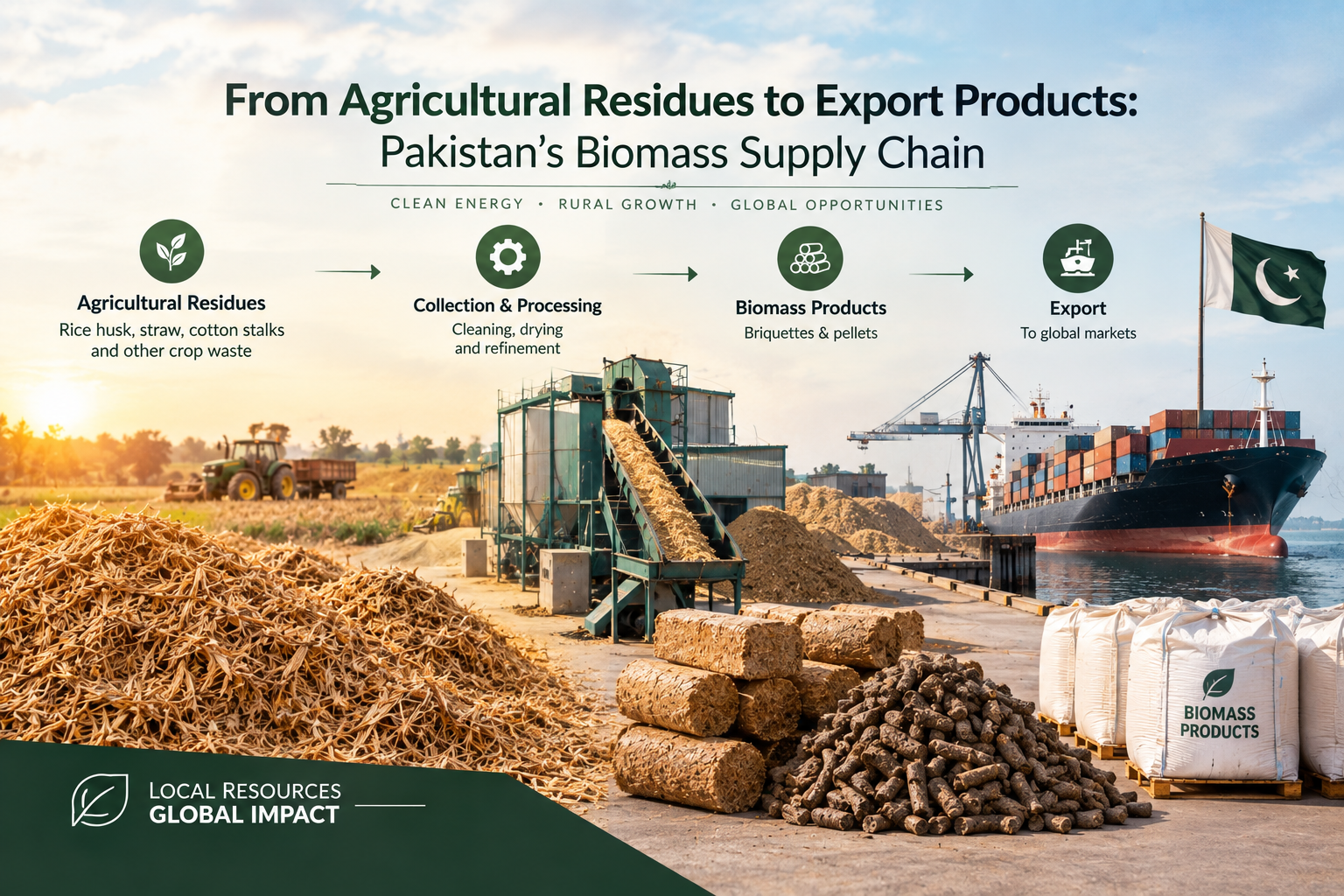
Every wheat harvest in Punjab leaves behind straw. Every rice mill in Sindh produces husk by the truckload. Every sugar season in southern Punjab generates bagasse and cane trash that piles up faster than local mills can use it. For decades, most of this material has been burned in the field, dumped, or left to rot — a disposal problem rather than a resource. That’s changing. Buyers in Europe and East Asia are now sourcing agricultural residues from Pakistan as feedstock for pellet mills, industrial boilers, and biomass power plants, and a real export supply chain is starting to take shape around crops that used to be considered waste.
If you’re evaluating Pakistan as a sourcing origin for biomass — whether you’re a European pellet importer, an Asian trading house, or a procurement manager for an industrial boiler operator — the practical questions are rarely about whether the raw material exists. It’s whether it can be collected, processed, and delivered in a form and volume that actually works for your operation. This article walks through agricultural residues to export products, how that supply chain works today, what determines quality and reliability, and what to check before signing a contract.
What “Agricultural Residue” Actually Means in Pakistan’s Context
Agricultural residue is simply the organic material left over after a crop’s primary product has been harvested and processed. In Pakistan, four crops generate the overwhelming majority of it: wheat, rice, sugarcane, and cotton.
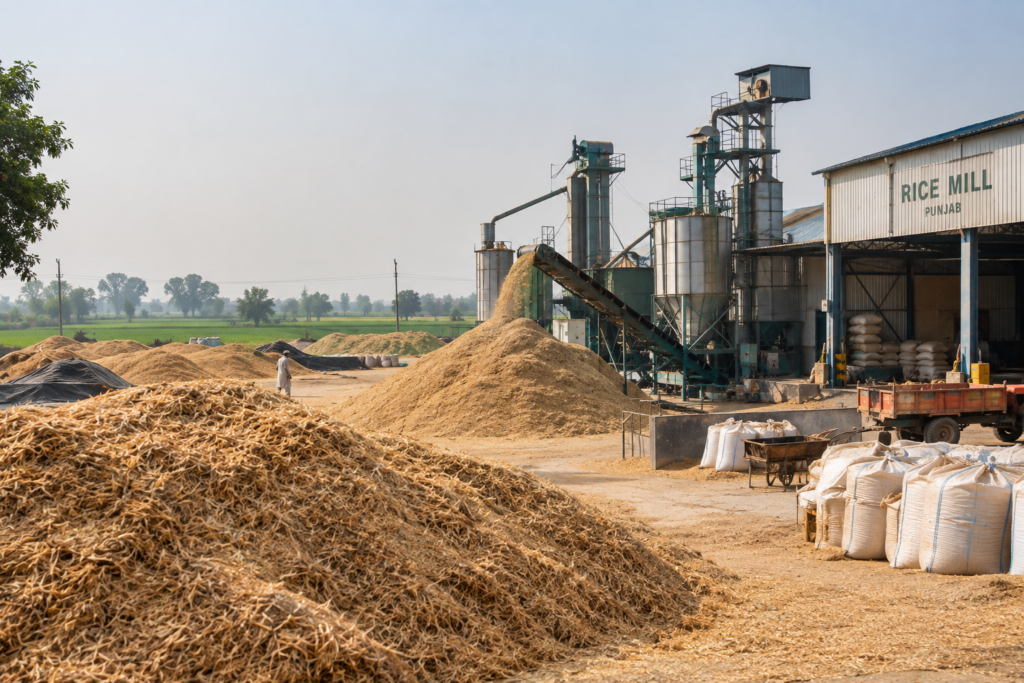
Wheat straw comes off the field after threshing. Rice generates two separate residue streams — rice straw in the field and rice husk at the mill, since husk is removed during the milling process rather than in the field. Sugarcane leaves both field trash (leaves and tops) and bagasse, the fibrous pulp left after the cane is crushed for juice. Cotton stalks remain standing after picking is complete.
Combined, wheat, rice, sugarcane, and cotton residues in Pakistan add up to well over 100 million tonnes a year, according to a review published in Frontiers in Chemical Engineering, which put the figure for the four main crops at 112.1 million tons per year. Not all of that is realistically collectible — a portion has to stay on or return to the field to protect soil structure and organic matter — but the raw volume explains why exporters and energy buyers alike see genuine long-term potential here, not a niche or temporary opportunity.
It’s worth being precise about terminology, because buyers sometimes use “biomass” and “agricultural residue” interchangeably when they’re not quite the same thing. Agricultural residue refers specifically to crop by-products. Biomass is the broader category that also includes purpose-grown energy crops, forestry residues, and organic waste streams. Pakistan’s export-relevant biomass is almost entirely agricultural residue — there is no significant dedicated energy-crop sector here — so when a supplier in Pakistan talks about “biomass,” they usually mean rice husk, wheat straw, cotton stalks, or bagasse in some processed form: raw, briquetted, or pelletized.
Why This Residue Has Become an Export Commodity
For a long time, burning was the default disposal method for field residues, particularly rice straw and wheat straw, because it’s fast and cheap for farmers working under tight turnaround windows between crop cycles. That practice carries a well-documented environmental cost — it’s a significant contributor to seasonal air quality problems in Punjab and northern India — which has pushed both governments and international agencies toward finding productive alternatives. The Food and Agriculture Organization has been directly involved in this shift regionally, running programs aimed at building crop residue value chains that support the collection, transport, and storage of residues like rice straw so they can be put to productive use rather than burned.
On the demand side, the driver is different but complementary. Countries in the EU, as well as South Korea and Japan, have renewable energy targets that depend partly on solid biomass fuel — wood pellets, agricultural pellets, and briquettes burned in industrial boilers or co-fired with coal in power stations. Domestic wood and agricultural residue supply in those markets often can’t keep pace with demand, which creates an opening for exporters in agriculturally dense countries like Pakistan, provided the material can be aggregated, processed, and shipped at a consistent quality.
That last condition — consistency — is the real bottleneck, and it’s the part most buyers underestimate when they first look at sourcing from Pakistan.
How the Supply Chain Actually Works, Step by Step
Collection. Residue collection starts at the farm or mill level. Rice husk and bagasse are relatively easy to source in volume because they’re generated as a byproduct at a fixed point — the rice mill and the sugar mill respectively — rather than scattered across thousands of small fields. Wheat straw and cotton stalks are harder to aggregate because they come directly off farmland, often from smallholdings, and require dedicated collection logistics (baling, transport) that add cost and time pressure, especially since there’s typically only a narrow window between harvest and the next planting cycle before the material needs to be cleared.
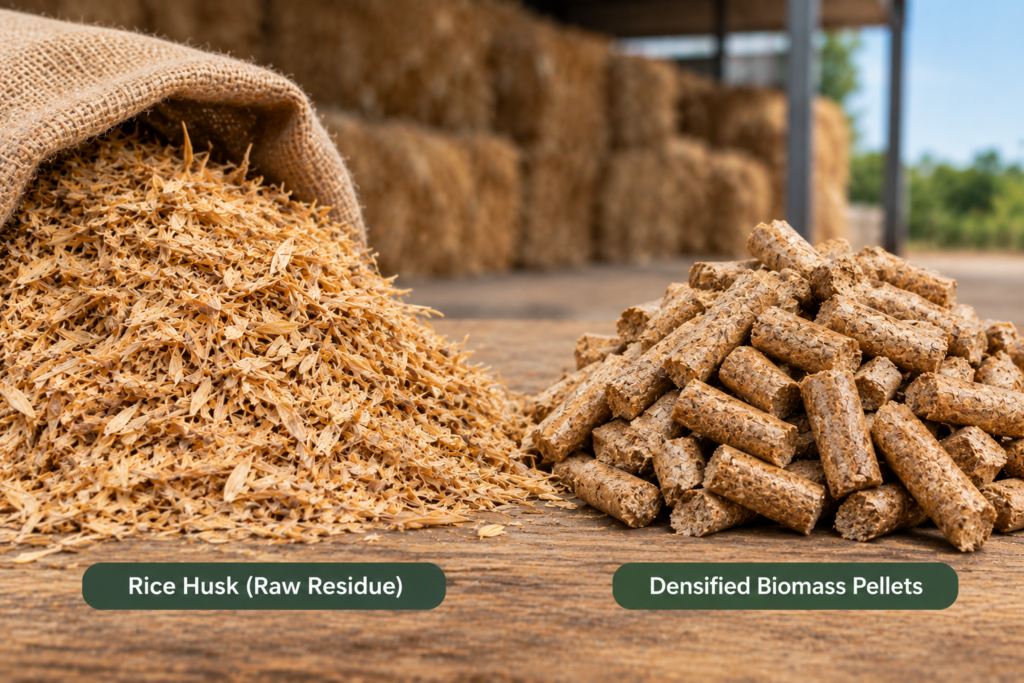
Processing. Raw residue is bulky, has inconsistent moisture content, and is expensive to ship in its raw form. Most export-grade material goes through some combination of drying, size reduction, and densification — compressing loose material into briquettes or pellets. Densification matters enormously for export economics: a container of loose rice husk wastes most of its volume on air, while pelletized husk packs far more energy value per cubic meter, which is what makes ocean freight viable at all.
Quality control. Buyers typically specify moisture content, ash content, calorific value, and bulk density, because these directly determine how the material performs in a boiler or pellet mill. Moisture above a certain threshold reduces heating value and can cause storage and handling problems; excess ash content affects combustion efficiency and creates disposal costs at the buyer’s end. A serious supplier should be able to provide test results for these parameters, ideally from an independent lab, rather than self-reported figures alone.
Storage and aggregation. Because residue generation is seasonal — tied to wheat, rice, sugarcane, and cotton harvest windows — exporters typically need warehousing to bridge the gap between harvest season and shipping schedules. A supplier who can only offer material immediately after harvest, with no storage capacity for the rest of the year, is signaling a real constraint on order flexibility.
Export logistics. From the processing site, material moves to port — usually Karachi or Port Qasim — for containerized or bulk shipment. Export documentation in Pakistan follows the country’s standard trade procedures, which have increasingly moved onto the government’s centralized digital platform for customs and regulatory clearances.
What Buyers Should Actually Evaluate Before Committing
If you’re sourcing agricultural residue or processed biomass from Pakistan, a few practical questions will tell you more than any marketing material:
Can the supplier document consistent specifications across shipments, not just one sample batch? A single good lab report proves the supplier can produce quality material once. What matters for an ongoing industrial buyer is whether that quality holds up shipment after shipment, across different points in the harvest season when moisture content and residue composition can shift.
Is the volume they’re quoting realistic against their actual collection network? Because most residue is aggregated from many smaller sources — mills, farms, ginning units — ask specifically how the supplier sources at the volumes being discussed. A trading company reselling material it doesn’t control the collection of carries different risk than a processor with direct mill or farm relationships.
What form is the material in, and does it match your equipment? Pellets, briquettes, and loose baled material behave very differently in storage, handling, and combustion equipment. Confirm the exact product form, dimensions, and packaging (bulk, bagged, or bin) before finalizing a contract — this affects everything from freight cost to how the material integrates with your existing feed system.
What documentation will accompany the shipment? For international trade, this typically includes a commercial invoice, packing list, certificate of origin, and phytosanitary or fumigation certification where applicable, since many agricultural residues fall under plant-product import controls in destination markets. Confirm early which certificates the destination country actually requires — these vary significantly between the EU, East Asia, and other markets, and gaps here are a common cause of customs delays.
Does pricing reflect current freight and seasonal supply conditions? Ocean freight rates and seasonal residue availability both move throughout the year. A quote that seems unusually low relative to current market conditions is worth questioning rather than accepting at face value.
Where Daa Agri Fits Into This Landscape
Daa Agri Limited operates in this space as a Pakistan-based agricultural products company working with crop residues and biomass materials for export. Companies positioned this way sit between the fragmented collection side of the supply chain — mills, ginning units, and farm-level aggregation — and international buyers who need consistent, documented, export-ready volumes. If you’re comparing suppliers, it’s reasonable to ask any company in this space, including Daa Agri, for the same specification data, sourcing transparency, and documentation practices outlined above — that’s the actual basis for a sound sourcing decision, regardless of which company you end up working with.
FAQ
Is agricultural residue the same as biomass?
Not exactly. Agricultural residue is a specific category of biomass — the crop byproducts left after harvesting or processing, such as rice husk or wheat straw. Biomass is the broader term that also covers energy crops, forestry residues, and other organic waste streams.
Which agricultural residues does Pakistan produce in exportable volume?
Rice husk, rice straw, wheat straw, cotton stalks, sugarcane bagasse, and cane trash are the main streams, largely because wheat, rice, sugarcane, and cotton are Pakistan’s dominant field crops by cultivated area.
Why is densification (pelletizing or briquetting) important for export?
Raw residue is bulky and low in density, which makes shipping it long distances uneconomical relative to its energy value. Compressing it into pellets or briquettes increases the energy density per shipping volume, which is generally what makes international freight costs viable.
What certifications or documents should I ask a Pakistani biomass supplier for?
At minimum, expect a commercial invoice, packing list, and certificate of origin. Depending on the destination country and product form, phytosanitary or fumigation certification may also be required, since plant-based export material is often subject to biosecurity controls. Requirements vary by destination market, so confirm them against your own country’s import rules rather than assuming they’re standard everywhere.
Does burning crop residue in the field affect the export supply?
Yes, indirectly. Field burning remains common in parts of Pakistan because it’s the fastest way to clear land between harvests, and it’s a widely documented seasonal air-quality issue in the region. Every tonne diverted from burning into collection for processing or export is a tonne added to available supply, which is part of why building better collection logistics matters for both environmental and commercial reasons.
How consistent is biomass supply throughout the year?
Not very, without storage infrastructure. Residue generation follows harvest seasons — wheat in spring, rice and cotton in autumn, sugarcane over the winter crushing season — so a supplier’s ability to offer material outside those windows depends on whether they have warehousing to bridge the gaps.
Sourcing biomass from a new country means evaluating documentation, consistency, and logistics as carefully as price. If you’re assessing Pakistan as a supply origin, Daa Agri is a starting point to compare specifications and discuss your specific volume and quality requirements directly with a supplier operating in this space.
Turn industry knowledge into a supply conversation.
Contact GreenCore for product availability, specifications, bulk packaging and export support.