
Biomass Suppliers in Pakistan: Wholesale and Bulk Buying Guide
Finding biomass suppliers in Pakistan is not hard. Finding one who can deliver the same dry, clean, correctly sized material […]
Finding biomass suppliers in Pakistan is not hard. Finding one who can deliver the same dry, clean, correctly sized material […]
Finding biomass suppliers in Pakistan is not hard. Finding one who can deliver the same dry, clean, correctly sized material every month is another matter. Residues come from thousands of farms, are collected by many hands and are exposed to weather and soil on the way. A supplier’s real value lies in how well they control that chaos.
This guide explains Biomass Suppliers in Pakistan for wholesalers, processors and industrial buyers planning bulk purchases. It covers the types of supplier you will meet, how to compare them, what to ask before ordering and how to protect yourself in the contract.
Understanding the Supply Landscape
Pakistan generates many kinds of agricultural residue. A World Bank-supported biomass mapping dataset on ENERGYDATA.info covers wheat straw, cotton stalk, rice straw and husk, maize stalk, cob and husk, sugarcane trash and bagasse, and distinguishes between theoretical volumes and what is realistically available given existing uses and farmer willingness to supply. That distinction matters to you as a buyer: ask suppliers where their material actually comes from, not just how much exists in the country.
Residues also follow harvest calendars, so continuity depends on planning and storage rather than on year-round production.
Types of Biomass Suppliers
Local collectors and traders. They aggregate from farms and markets. Prices can be attractive and response fast, but control over drying, cleaning and consistency is often limited.
Small processors. They chop, grind or bale residues. Quality varies and export documentation may be thin.
Mill-linked suppliers. Sugar and rice mills generate by-products on site. Many use these themselves, for instance as boiler fuel. Dawn has noted that almost all sugar mills run in-house bagasse cogeneration plants, which limits what is left for sale.
Export-oriented processors. They run collection, cleaning, drying, processing, packing and shipping as one chain, which makes accountability simpler.
What to Check Before You Commit
Exactly what is being sold
“Biomass” is not a specification. Ask for the residue name, form (chopped, ground, granulated), and target size.
Moisture and drying
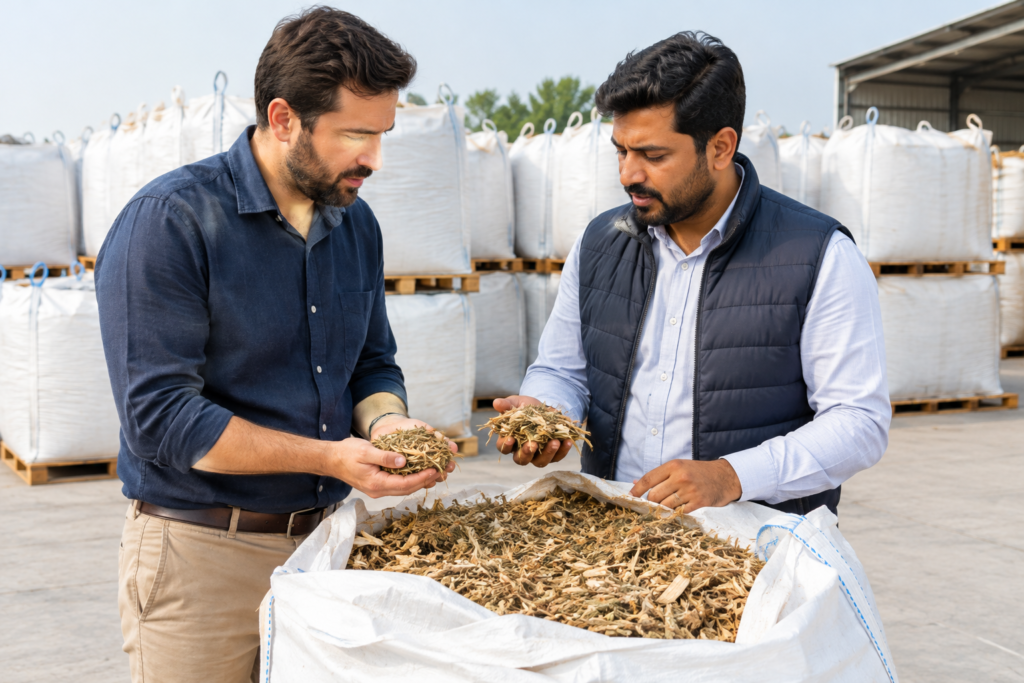
Request the maximum moisture level and the test method. Plant residues shipped damp are the most common source of rejected consignments.
Cleaning and contamination
Ask how soil, stones and foreign matter are removed before packing.
Fuel properties, if relevant
For energy buyers, ISO 17225 provides a framework. Its general standard covers fuel specifications and classes for solid biofuels, and the non-woody pellet part notes that agricultural biomass tends to have higher ash, chlorine, nitrogen and sulfur contents. Request laboratory analysis for your intended use.
Consistency across lots
One excellent sample proves little. Ask how the supplier keeps lots uniform and whether retained samples are kept for later comparison.
Packing and loading
PP bags and jumbo bags are common. Ask about bag weight, container loading method and how moisture protection is handled.
Questions to Put to Every Supplier
- Which residue and form do you offer, and in what size range?
- What is the maximum moisture, and how is it tested?
- How are cobs, tops or other residues cleaned before packing?
- What are your minimum order quantity and lead time?
- Can you supply a sample before the first order?
- What documents accompany each shipment?
- How do you handle claims if goods differ from the agreed specification?
Seasonality and Continuity
Because residue supply tracks harvests, ask how a supplier collects and stores material across the year. A structured seasonal sourcing plan is more reassuring than a promise of unlimited availability.
Commercial Terms and Logistics
Agree an Incoterm at the start. The Trade Development Authority of Pakistan explains that terms such as FOB and CIF are standard business custom and set out each party’s costs and risks. Your freight forwarder or customs broker should confirm destination-country requirements, which vary by end use.
Bulky material means freight is a major cost driver, so ask how many tonnes fit in a container with your chosen packing.
Red Flags
- Unwillingness to provide a sample.
- No clear answer on moisture or cleaning.
- A price far below every other quote with no explanation.
- Specifications that change between quotation and contract.
- No written terms.
Supply from Daa Agri Limited
Daa Agri Limited is a Pakistan-based agricultural processing and export company working across a circular agricultural value chain. Its profile lists corn cob meal, corn cob granules and processed sugarcane tops and field residues as core export products, and highlights structured seasonal sourcing, a supplier network across Punjab and surrounding regions, flexible bulk supply capacity and export-ready packing in PP and jumbo bags.
The company’s profile names mushroom cultivation, animal feed and organic agriculture as the industries it serves. Buyers with other applications, such as energy use, should confirm specifications directly. Send your intended use, form, volume and destination port to discuss availability.
Conclusion
The best biomass suppliers in Pakistan are the ones who can document their process, answer moisture questions clearly and deliver the same material shipment after shipment. Test samples, trial small orders, keep every term in writing and build volume once consistency is proven.
To discuss bulk supply or request a quotation, contact Daa Agri Limited at info@daaagri.com.
Turn industry knowledge into a supply conversation.
Contact GreenCore for product availability, specifications, bulk packaging and export support.