
How to Buy Agricultural Products from Pakistan for International Export Markets
Pakistan sits at an interesting crossroads for international buyers. It is among the world’s top producers of rice, wheat, mangoes, […]
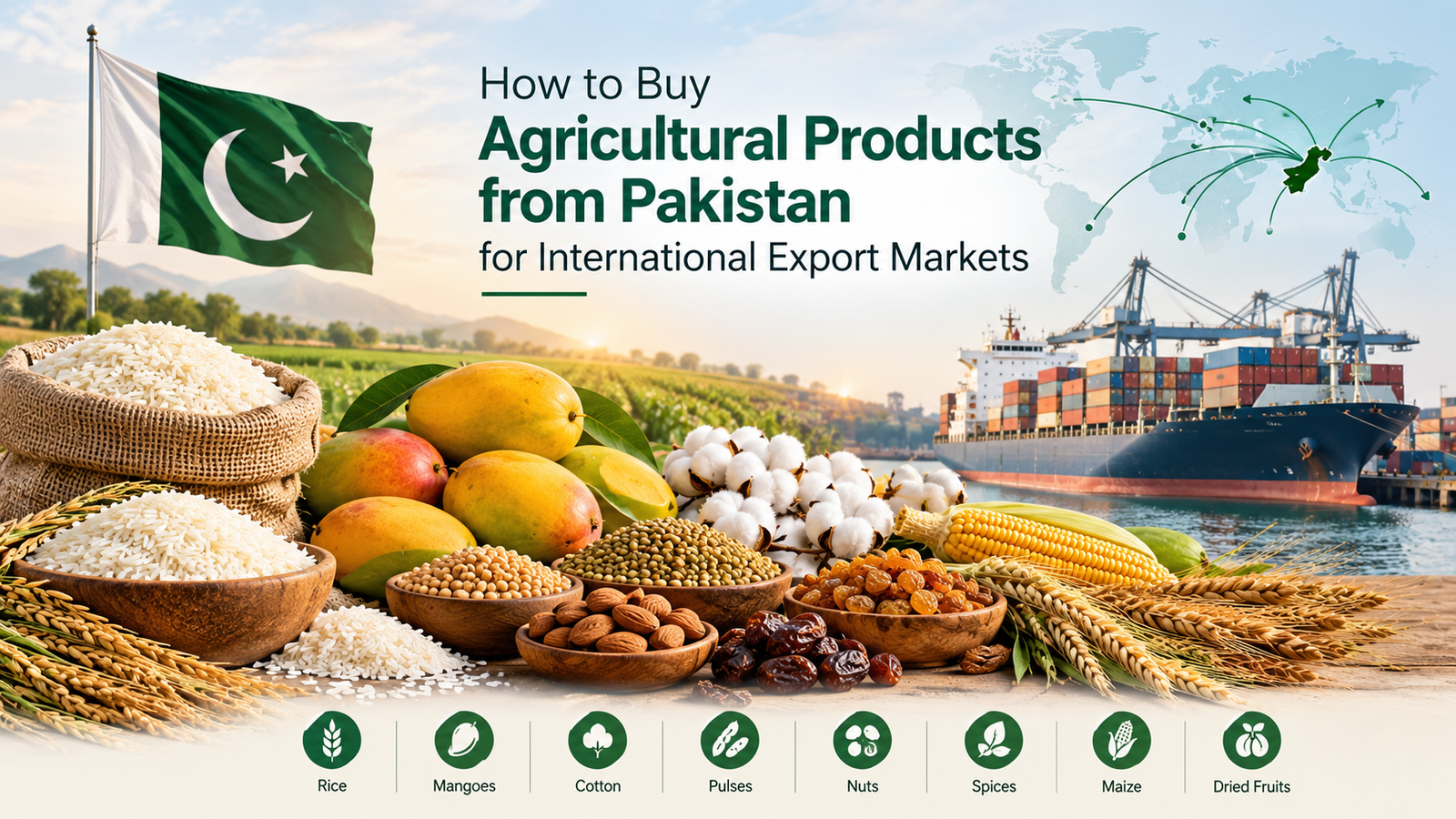
Pakistan sits at an interesting crossroads for international buyers. It is among the world’s top producers of rice, wheat, mangoes, […]
Pakistan sits at an interesting crossroads for international buyers. It is among the world’s top producers of rice, wheat, mangoes, dates, chickpeas, and a range of fresh vegetables — yet for many importers outside the region, the practical mechanics of sourcing from Pakistani suppliers remain unclear. Which products are genuinely export-ready? What documentation should you expect? How do you separate a capable agro exporter from one that will cost you a failed shipment?
This guide is written for procurement managers, importers, wholesale distributors, and private-label brand owners who are seriously considering to buy agriculture products from Pakistan. It covers what the Pakistani agri-export sector actually produces, how the export process works, what documents you should require, and what to look for when evaluating Pakistan agricultural suppliers.
Why Pakistan Matters to International Agricultural Buyers
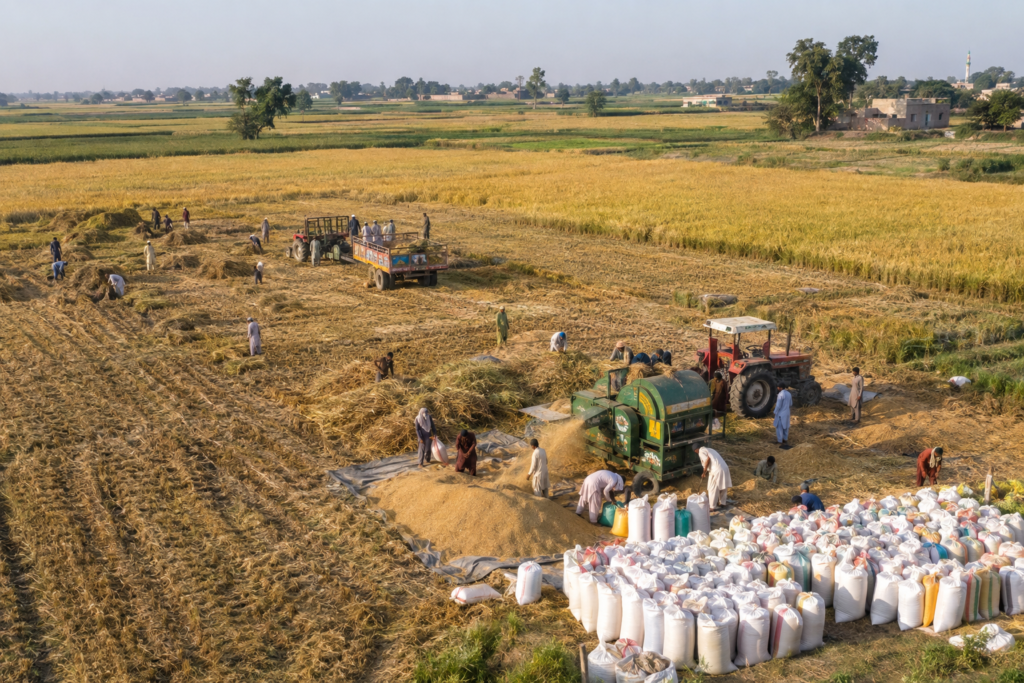
Pakistan’s agriculture sector is not a marginal part of the economy. Agriculture accounts for roughly 24 percent of GDP and employs a substantial share of the workforce, according to Pakistan’s Economic Survey 2023–24 published by the Finance Ministry. That scale — 22 million hectares of cultivated land producing crops across two seasons — translates into meaningful export volumes across a surprising range of commodities.
According to the Trade Development Authority of Pakistan (TDAP), Pakistan’s agro-food exports reached approximately $8 billion in fiscal year 2023–24, with rice alone generating nearly $3.9 billion of that total. Beyond rice, significant export volumes flow in vegetables ($399 million), fruits ($333 million), meat ($507 million), oilseeds ($410 million), and seafood ($406 million).
For international buyers, those numbers matter for a practical reason: when a commodity has an established export infrastructure — processing facilities, logistics networks, experienced intermediaries — sourcing it becomes considerably more predictable than working with an emerging supplier country that lacks that base.
Pakistan’s core exportable agricultural commodities currently include:
- Rice (Basmati and non-Basmati varieties)
- Fresh and processed mangoes
- Citrus fruits (kinnow/mandarins primarily)
- Onions and potatoes
- Dates
- Fresh vegetables (okra, chilies, bitter gourd, peas, and others)
- Sesame seeds
- Maize/corn
- Halal red meat
- Seafood and crustaceans
- Cotton and cotton yarn
- Spices and herbs
Not every product on that list will suit every buyer’s requirements or destination market. Understanding which categories have mature export infrastructure — and which are still developing it — saves time during the supplier selection process.
Understanding the Pakistani Agro-Export Ecosystem
Growers, Traders, and Exporters
The supply chain from Pakistani farm to export container typically involves more hands than buyers from vertically integrated agricultural markets might expect.
At the production level, most Pakistani agricultural output comes from smallholder farming operations. Smallholder farmers typically sell into local mandi (wholesale market) systems, where commodity traders aggregate produce from hundreds of individual farms. Those traders then sell to processors or directly to export-licensed companies.
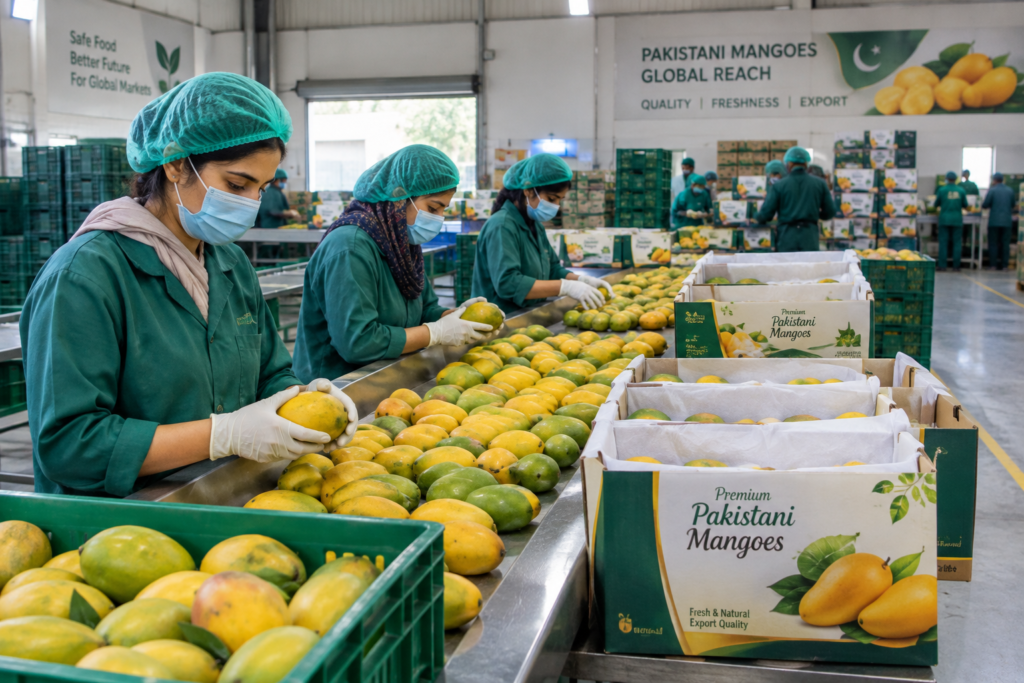
Some larger operations in Pakistan do practice vertical integration — controlling growing, post-harvest processing, grading, and packing under one roof. These tend to be more common in sectors like rice milling and frozen vegetable processing. In fresh produce, the more typical model is an exporter that aggregates from multiple suppliers and handles the grading, packing, and documentation in-house.
For international buyers, the distinction matters when it comes to consistency. A trader working from multiple uncontrolled sources may not deliver the same grade across different shipments. An exporter who owns or directly contracts the processing stage has more control over specifications. When evaluating agro exporters from Pakistan, ask specifically about where their processing happens, who controls grading, and what their quality rejection rate looks like.
Export Licensing and Regulatory Structure
Exporters of agricultural products from Pakistan are required to be registered with the relevant trade authorities. For rice exporters, registration with the Trade Development Authority of Pakistan is the appropriate reference point. Horticulture exporters dealing in fruits and vegetables fall under the oversight of TDAP’s Agro & Food Division and, for fresh produce specifically, may also be registered with the Pakistan Horticulture Development & Export Company (PHDEC).
A registered exporter is not automatically a reliable one, but the absence of registration is a genuine red flag. Always ask prospective Pakistan agricultural suppliers for their export registration number and verify it independently where possible.
The Export Documentation Framework
Understanding what documents accompany a Pakistani agricultural shipment is essential before you finalise any supply agreement. Missing or incorrect paperwork causes delays at destination ports, customs holds, and potential destruction of perishable cargo.
Standard Export Documents
Most agricultural consignments from Pakistan will require or generate the following:
Commercial Invoice — Issued by the exporter, detailing product, quantity, grade, price, and buyer information. Your import authority will use this for customs valuation.
Packing List — Item-by-item breakdown of the consignment, including weight, dimensions, and packing type. Discrepancies between the packing list and the actual cargo create clearance problems.
Bill of Lading or Airway Bill — The shipping document issued by the carrier. For most bulk agricultural products, sea freight is standard, making the Bill of Lading the relevant document.
Certificate of Origin — Required by most destination countries for customs duty purposes. Pakistan-origin certificates are issued through authorised chambers of commerce and TDAP-registered entities.
Phytosanitary Certificate — This document is mandatory for all plant-based agricultural products. It is issued by Pakistan’s Department of Plant Protection (DPP) under the Ministry of National Food Security and Research. It certifies that the consignment has been inspected and found free from quarantine pests and diseases according to the importing country’s requirements. The Pakistan Single Window (PSW) platform has digitalised phytosanitary certificate issuance since late 2023, enabling electronic exchange of these certificates with over 70 countries — which streamlines the process considerably compared to manual paper submissions.
Health Certificate / Sanitary Certificate — Required for animal products including meat, seafood, and dairy and issued through relevant Pakistani government departments.
Halal Certificate — Required for meat products destined for Muslim-majority markets or for halal retail channels in Western countries. Buyers should verify that the specific certification body is accepted in their destination country.
Quality and Weight Certificate — Often required by buyers and sometimes by destination customs authorities and typically issued by independent inspection bodies such as SGS, Bureau Veritas, or Intertek operating in Pakistan.
What Buyers Should Verify Upfront
Before any commercial arrangement is finalised, clarify which documents your destination country requires for each specific product category. Regulatory requirements differ by country and by commodity. Your freight forwarder or customs broker in the destination market is usually the most reliable source for this information — not the exporter’s sales representative, who has an obvious interest in simplifying the import process during the sales conversation.
For the EU, additional residue testing may be required for certain fresh produce categories. For the GCC (Gulf Cooperation Council) markets, Halal compliance is typically mandatory for meat. For China, GACC (General Administration of Customs of China) registration of the exporting facility is required for many food categories. These requirements change, so rely on current official guidance rather than general assumptions.
How to Find and Evaluate Pakistani Agricultural Suppliers
Where to Start
TDAP Supplier Directories — The Trade Development Authority of Pakistan maintains industry-specific supplier information and organises international trade exhibitions, including the FOODAg event in Karachi. This is a verified, official channel for connecting with export-registered Pakistani agro companies.
Pakistan Single Window’s Tradeverse portal — The Pakistan Single Window’s Tradeverse platform functions as a trade information portal where buyers can find regulatory information and connect with the Pakistani export ecosystem.
Trade Exhibitions — International food and agricultural trade shows (including in the UAE, UK, Germany, and China) increasingly feature Pakistani exhibitors. These in-person encounters allow buyers to assess communication quality, sample products, and verify that a supplier has the organisational capacity to manage international orders.
Referrals from freight forwarders and customs brokers — Logistics professionals who work with Pakistani origin regularly know which exporters are operationally competent and which generate frequent documentation problems or quality disputes.
What to Evaluate in a Supplier
Export track record — A supplier should be able to demonstrate verifiable export history. Ask for Bill of Lading copies from previous shipments, destination countries served, and contact references from existing buyers you can independently contact.
Processing and packing capability — Visit the facility if the order volume justifies it, or commission a third-party inspection of the processing site. For high-value or high-frequency purchasing programs, a pre-qualification facility audit is worth the cost.
Quality certifications — Depending on your destination market and buyer requirements, relevant certifications may include ISO 22000, HACCP, GlobalGAP (for fresh produce), and organic certification. Verify the certification body’s accreditation. A certificate from an unrecognised body provides no meaningful assurance.
Pesticide residue compliance — This is particularly important for buyers supplying European retail channels. Pakistan has faced instances of agricultural shipments being rejected at EU ports due to pesticide residue levels exceeding Maximum Residue Levels (MRLs). Responsible exporters for the EU market should be able to provide recent laboratory test results from accredited testing facilities.
Communication and responsiveness — This sounds obvious, but it is consistently cited as a pain point by importers working with new Pakistani suppliers. A supplier who responds slowly during the sales process is unlikely to respond faster once payment has been made.
Payment terms and trade finance — Common terms for Pakistan agricultural exports include advance payment (T/T in advance), Letter of Credit (LC at sight or deferred), and Documents Against Payment (D/P). The appropriate structure depends on your established relationship and order volume. For a first order, most suppliers will request either full or partial advance payment or a confirmed LC — treat requests for open account terms from an unknown supplier with appropriate caution.
Product-Specific Buying Considerations
Rice
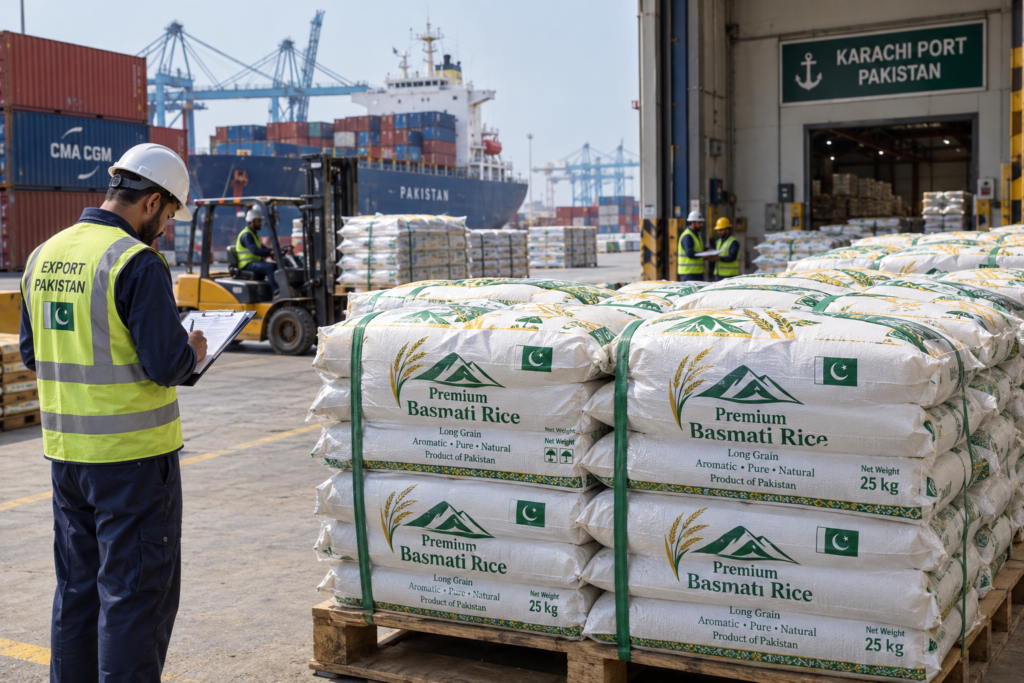
Pakistan is one of the world’s largest rice exporters, with multiple varieties available for international buyers. Basmati rice — particularly varieties like PK-386 and Super Basmati — commands premium pricing and is primarily destined for the Middle East, Europe, and North America. Non-Basmati varieties are exported in larger volumes at lower price points to Asian and African markets.
When specifying rice from Pakistani suppliers, buyers should define:
- Variety (Basmati vs. non-Basmati, specific variety name)
- Milling degree (raw/brown, parboiled, half-milled, fully milled/white)
- Grain length (extra-long, long, medium)
- Broken percentage (1%, 5%, 25%, 100% broken; the acceptable tolerance should be agreed in writing)
- Moisture content (typically specified at 13–14% maximum)
- Chalky grains percentage
- Foreign matter and paddy grain limits
- Packaging (25 kg, 50 kg bags, or bulk; woven PP, jute, or laminated bags)
Without written specifications, “rice” is not a useful procurement description. A reputable Pakistani rice exporter will expect and welcome detailed spec sheets — and should be able to provide samples of the specific grade they are offering before contract signature.
Fresh Fruits and Vegetables
Pakistan’s horticultural export sector has grown considerably, with mangoes, kinnow citrus, and fresh vegetables reaching markets in the GCC, UK, EU, China, and Russia. However, fresh produce sourcing from Pakistan requires more careful logistical planning than dry goods.
Key buyer considerations include:
Seasonality — Pakistani mangoes are typically available May through August; kinnow citrus runs November through March; vegetables vary by crop. Buyers building annual supply programs need to plan around these windows.
Cold chain compliance — Fresh produce quality is directly dependent on cold chain management from field through to container. Ask suppliers explicitly about pre-cooling facilities, reefer container booking lead times, and their track record for maintaining temperature logs.
Shelf life on arrival — Factor in transit time and remaining shelf life at destination. For EU and UK markets via sea, transit from Karachi typically runs 20–25 days. For GCC destinations, it can be as short as 4–6 days.
Residue testing — As noted above, this is a regulatory requirement in several major markets, not an optional quality check.
Spices and Dry Commodities
Pakistan exports sesame seeds, chilies, coriander, fenugreek, and other spices and dry commodities. For these categories, moisture content, foreign matter levels, aflatoxin contamination (particularly for chilies and spices), and labelling compliance for the destination country are the primary buyer concerns. Ask for a Certificate of Analysis (COA) from accredited laboratories covering the specific parameters required by your import regulations.
Practical Steps for First-Time Buyers
If you are approaching the Pakistani agricultural market for the first time, a structured process reduces the risk of a costly early mistake.
Step 1 — Define your specification before approaching suppliers. Know exactly what you need: commodity, grade, packaging, quantity, destination port, and required certifications. A clear RFQ (Request for Quotation) will generate comparable responses and signal to serious exporters that you are a capable buyer.
Step 2 — Request samples before committing to a commercial order. A supplier who hesitates to provide pre-shipment samples is a supplier to approach carefully. Sampling is standard practice; their willingness (and speed) to provide it is informative.
Step 3 — Verify independently. Check the exporter’s registration with TDAP or the relevant authority. Verify certifications directly with the certification body. If your order justifies it, commission an inspection of the facility through a third-party inspection company before finalising the supply agreement.
Step 4 — Start with a trial shipment. Even if your target volume is large, a first shipment at a smaller quantity allows you to verify the entire process — documentation quality, packing accuracy, product conformance, and communication during transit — before scaling commitment.
Step 5 — Use a structured supply agreement. A purchase order alone is insufficient for international agricultural procurement. A written supply agreement covering product specifications, inspection rights, rejection procedures, payment terms, claims procedures, and applicable law creates a useful framework if disputes arise.
Step 6 — Work with a knowledgeable freight forwarder. Freight forwarders with established Pakistan-origin experience can advise on port logistics at Karachi and Port Qasim, handle documentation, and often provide early warning when a supplier’s shipping preparation is running behind schedule.
Working with Daa Agri Limited
For buyers looking to source agricultural products from Pakistan through a dedicated export partner, Daa Agri Limited operates in this space as a Pakistan-based agro supplier. Because they focus on agricultural product supply for international markets, buyers exploring sourcing from Pakistan can use them as a starting point for product inquiries and export guidance.
If you are evaluating supply options, please reach out to the Daa Agri team directly to confirm their current product availability, grade specifications, and export process. These details are best confirmed through direct supplier dialogue rather than general research.
FAQ: Buying Agricultural Products from Pakistan
Q: What are the most reliable agricultural products to buy from Pakistan?
Rice, sesame seeds, dates, and dried spices have the most mature export infrastructure and the most consistent quality track record. Fresh produce (mangoes, kinnow, vegetables) is highly viable but requires more careful logistical planning, particularly around cold chain management and shelf life.
Q: Is a Phytosanitary Certificate always required for Pakistani agricultural imports?
For plant-based agricultural products, yes. The Phytosanitary Certificate issued by Pakistan’s Department of Plant Protection is mandatory for imports into virtually all countries that follow international plant quarantine conventions. Your destination country may also specify additional requirements beyond the standard certificate.
Q: How do I verify that a Pakistani agricultural exporter is legitimate?
Cross-check their stated export registration with TDAP or the relevant sector authority. Request copies of previous Bills of Lading showing actual export history. Ask for trade references from existing international buyers and verify them independently. For high-value programs, commission a facility audit through a recognised third-party inspection company.
Q: What payment terms are typical for Pakistani agricultural exports?
First orders commonly operate on advance TT payment or a confirmed Letter of Credit. As a trading relationship develops and both parties build confidence, other structures may become possible. Approach any Pakistani exporter who immediately offers open account terms for a first order with caution.
Q: Can I specify custom packaging and labelling for products sourced from Pakistan?
For processed and dry products such as rice, yes — most established exporters can accommodate buyer-specified packaging materials, sizes, and label designs, subject to minimum order quantities. For fresh produce, packaging options are generally more limited and product-specific. Clarify packaging capabilities and any associated cost implications before finalising your specification.
Q: Do Pakistani agricultural products meet EU food safety standards?
Some categories do consistently; others have a more variable track record. Pakistani Basmati rice is well established in the EU market. For some fresh produce categories, pesticide residue compliance has been a documented concern in EU import checks. Buyers targeting EU retail channels should explicitly require recent laboratory test results against EU MRL standards, and should discuss the supplier’s pesticide management program directly.
Conclusion
Pakistan’s agricultural export sector offers genuine value for international buyers across a range of commodities — but it rewards buyers who approach it with preparation. Clear specifications, independent verification, structured agreements, and a willingness to start with manageable trial volumes produce better outcomes than rushing to volume on the strength of a sales conversation.
The export infrastructure is real, the product range is broad, and the sector has demonstrated consistent growth in recent years. Buyers who invest in properly qualifying their Pakistan agricultural suppliers tend to find the sourcing relationship both productive and cost-effective over time.
To explore sourcing agricultural products from Pakistan, visit Daa Agri Limited to discuss your specific product requirements and get started with a supplier inquiry.
Turn industry knowledge into a supply conversation.
Contact GreenCore for product availability, specifications, bulk packaging and export support.